

- Body of Osman Hadi Returns to Dhaka From Singapore Late |
- Fakhrul condemns attacks on media, calls for unity, justice |
- 2 cops among 4 hurt in clash outside Indian Assit H.C. in Ctg |
- Inqilab Moncho urges people to avoid violence |
- Hadi’s death: Prothom Alo, Daily Star offices set afire |
Gaza Famine Eases, but Millions Still Face Hunger: UN
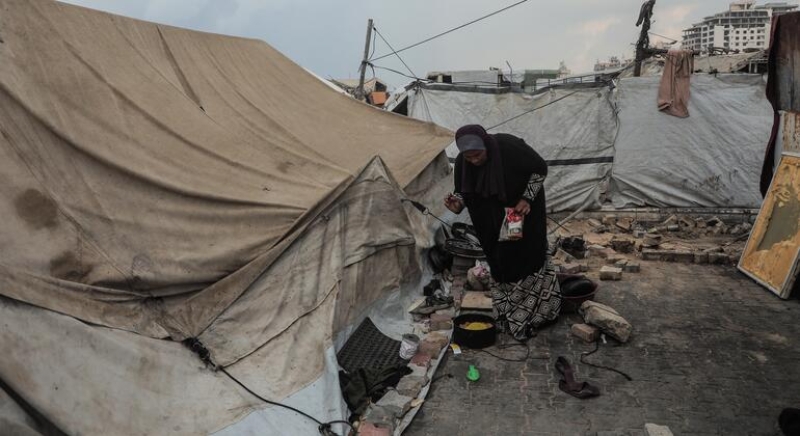
Hunger and malnutrition rates remain alarmingly high across Gaza Strip. Pictured here, a woman prepares food in Gaza City after a night of rain and wind.
Food security in Gaza has improved since the ceasefire declared in October, pushing back famine conditions, but the situation remains critical, with more than three-quarters of the population still facing acute hunger and malnutrition, according to a new UN-backed analysis.
The latest Integrated Food Security Phase Classification (IPC) report—a global system tracking malnutrition and food insecurity—found that no areas of Gaza are currently classified as being in famine (IPC Phase 5). This improvement follows increased humanitarian and commercial access after the 10 October ceasefire.
However, nearly the entire Gaza Strip remains in an emergency situation (IPC Phase 4), with hundreds of thousands of people still experiencing very high levels of acute malnutrition.
Between mid-October and the end of November, around 1.6 million people—about 77 per cent of the analysed population—faced crisis-level hunger (Phase 3) or worse. This included more than 500,000 people in emergency (Phase 4) and over 100,000 people in catastrophe (Phase 5), the report said.
Gains ‘perilously fragile’
UN Secretary-General António Guterres said the findings show progress but warned that the gains remain “fragile—perilously so.”
“Famine has been pushed back. Far more people are able to access the food they need to survive,” he told reporters at UN headquarters in New York.
However, he cautioned that 1.6 million people in Gaza—more than 75 per cent of the population—are still projected to face extreme levels of acute food insecurity and critical malnutrition risks.
The IPC analysis projects that through mid-April 2026, around 571,000 people will remain in emergency conditions, while approximately 1,900 people are expected to continue facing catastrophe-level hunger. Under a worst-case scenario—including renewed hostilities or a halt in humanitarian and commercial inflows—the entire Gaza Strip could again face famine.
Malnutrition a major concern
Malnutrition remains a serious concern, particularly among children and pregnant and breastfeeding women.
Nearly 101,000 children aged six to 59 months are expected to suffer from acute malnutrition through mid-October 2026, including more than 31,000 severe cases. An estimated 37,000 pregnant and breastfeeding women are also projected to require treatment.
While food aid has increased, the report stresses that assistance largely meets only basic survival needs. Health services, water and sanitation systems, housing and livelihoods remain badly damaged, leaving families especially vulnerable during winter.
Call for durable ceasefire
“Families are enduring the unendurable,” Mr. Guterres said, citing children sleeping in flooded tents and buildings collapsing under heavy rain and wind.
He said humanitarian teams are preparing more than 1.5 million hot meals daily, reopening nutrition centres and restoring water and health services, but warned that needs continue to outpace aid delivery.
Calling for a “truly durable ceasefire,” he urged more crossings into Gaza, fewer restrictions on critical supplies, safe internal routes, sustained funding and unimpeded humanitarian access.
The IPC report warned that without continued and expanded access, sustained aid and the rebuilding of essential infrastructure, Gaza’s food security situation could quickly deteriorate again, with long-lasting consequences for an already traumatised population.