

Saturday, December 6, 2025
News update
- কলাপাড়া মুক্ত দিবসে এবার সাড়া নেই কার |
- One killed, two injured in attack at Ctg meeting over marriage |
- Dhaka ranks world’s third worst in air quality Saturday |
- Sylhet residents endure mosquito invasion amid dengue surge |
- Lioness brought back to Zoo cage after one hour of escape |
New Gaza Governance Body Expected by Year’s End
GreenWatch Desk:
International
2025-12-06, 8:49pm
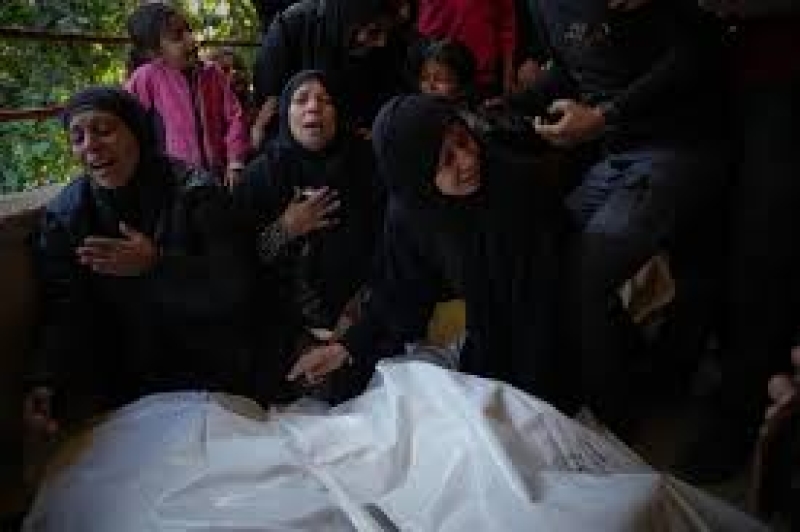
Mourners attend the funeral of Palestinians killed in an Israeli military strike, at Nasser Hospital in Khan Younis, Gaza Strip, Thursday, Dec. 4, 2025.
An international authority tasked with overseeing the next phase of Gaza’s U.S.-brokered ceasefire is expected to be announced before year’s end, according to an Arab official and a Western diplomat familiar with the negotiations.
Under the ceasefire terms, the body — known as the Board of Peace and chaired by U.S. President Donald Trump — would guide Gaza’s reconstruction under a two-year renewable mandate. The officials said it will likely include roughly a dozen representatives from regional and Western nations, speaking on condition of anonymity.
A separate committee of Palestinian technocrats is also set to be introduced to manage day-to-day administration in post-war Gaza. The Western diplomat said the timing of the announcement may coincide with Trump’s meeting with Israeli Prime Minister Benjamin Netanyahu later this month.
The agreement further calls for the creation of an armed International Stabilization Force to secure Gaza and oversee the disarmament of Hamas, a central Israeli demand. If implemented, it would mark progress toward Trump’s 20-point framework for stabilizing Gaza after two years of Israeli military operations against the group.
The truce, in effect since Oct. 10, has been strained by sporadic clashes and mutual accusations of violations. The first phase is nearing completion, though Hamas has yet to return the remains of the final Israeli hostage required under the deal.
Talks continue over which countries will provide troops to the stabilization force. Deployment is expected in the first quarter of 2026, a timeline echoed by a U.S. official who said an international presence on the ground could materialize early next year.
Negotiations on the second phase of the ceasefire are set to intensify soon, centering on the difficult question of Hamas disarmament. The plan envisions Israeli forces withdrawing from remaining areas of Gaza as the new international force begins its deployment.
Key issues remain unresolved, including funding for reconstruction. Some Palestinians have voiced concerns about the absence of Palestinian political representation in the new governing authority and the lack of a concrete path toward statehood. Netanyahu’s government maintains its opposition to a Palestinian state, while the deal offers only a vague outline tied to future conditions.
Israel, meanwhile, said it intends to reopen the Rafah border crossing with Egypt in the coming days as stipulated in the ceasefire. The move could allow Palestinians to leave Gaza for the first time in nearly two years. However, Egypt, Jordan, the UAE, Indonesia, Pakistan, Turkey, Saudi Arabia and Qatar expressed deep concern, insisting the crossing must permit movement both into and out of Gaza.
Egypt has said it will support reopening only if Palestinians are allowed to return, while Israel maintains returns cannot begin until the remains of the final Israeli hostages are recovered.
In a joint statement, the eight nations said Rafah must allow full freedom of movement and warned against any effort to displace Palestinians from their land.
Fresh violence added to the fragile atmosphere on Friday. Israeli forces said they killed a man in northern Gaza who approached troops alongside another man carrying “suspicious objects.” In the occupied West Bank, a 38-year-old Palestinian man was killed; the Palestinian Health Ministry said he was shot by Israeli forces, while the military said he had thrown a rock.
The incidents contributed to concerns that rising tensions could jeopardize the tenuous truce.
The current conflict began after Hamas-led militants attacked southern Israel on Oct. 7, 2023, killing about 1,200 people and taking more than 250 hostages. Israel’s subsequent offensive in Gaza has killed more than 70,100 Palestinians, according to the Gaza Health Ministry, whose figures are widely considered credible by international humanitarian organizations.