

- Gas Crisis Deepens as LNG Outage Hits Supply |
- Microplastics Found in 26 of 34 Toothpaste Brands in Bangladesh |
- Shahabuddin Set to Leave Bangabhaban, Hafiz Takes Charge |
- Rail Expansion Planned for 16 Unconnected Districts |
- Rescued elephant Badsha Bahadur gets a second chance to survive |
UN Urges Gaza Ceasefire, Hostage Release Amid Crisis
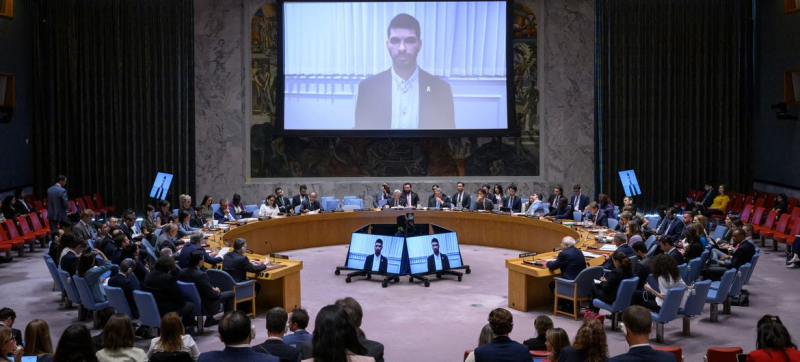
A wide view of the Security Council meeting on the situation in the Middle East, including the Palestinian question.
As conditions in the Occupied Palestinian Territory and Israel continue to deteriorate, a senior UN official stressed the need for a political solution to the Gaza crisis that could lead to lasting peace between the two peoples.
Assistant Secretary-General Miroslav Jenča briefed a Security Council meeting on Tuesday, convened by Israel to discuss the plight of hostages still being held in the war-ravaged enclave.
The meeting followed the release by Hamas and Palestinian Islamic Jihad of images and videos showing two emaciated hostages, Evaytar David and Rom Braslavsky, sparking outrage and condemnation.
“The scenes of Evaytar apparently being forced to dig his own grave are appalling,” Mr. Jenča said.
“These images, and their own accounts of their treatment, have horrified us all. They are an affront to humanity itself.”
Mr. Jenča acknowledged the presence of Mr. David’s brother, Ilay, who joined the meeting via videoconference, saying the UN recognises “the profound pain and hardship endured by the families and loved ones of those who remain in captivity.”
He noted that this week the Jewish community commemorated Tisha B’Av, a day of mourning and remembrance for tragedies endured throughout its history.
“I pay tribute to your courage and determination, and I share your dearest wish: for your brother, and all hostages held in Gaza, to be immediately and unconditionally released,” he said.
Currently, 50 hostages are being held by Hamas and other Palestinian armed groups in horrific conditions, and 28 are believed to be dead. Freed hostages “have relayed distressing accounts of deprivation, ill-treatment, and abuse.”
Since the conflict began, Hamas and other armed groups have released dozens of hostage videos, including statements made under duress and while visibly suffering, most recently those of the two men.
“International law is clear,” said Mr. Jenča. “Hostage-taking is prohibited – it is a war crime.”
He stressed that people deprived of their liberty must be treated humanely and with dignity and must be allowed visits from the International Committee of the Red Cross (ICRC).
“They must never be subjected to ill-treatment, abuse, or humiliation, as these would also constitute violations of international law,” he added, reiterating UN Secretary-General António Guterres’s call for the immediate and unconditional release of all hostages.
Meanwhile, “the situation in Gaza is horrifying – it is unbearable,” Mr. Jenča continued, noting that “Palestinians are subjected to squalid, inhumane conditions on a daily basis.”
More than 60,000 Palestinians have been killed since the conflict began, according to local health authorities.
“Since the end of May, over 1,200 Palestinians have been killed and more than 8,100 injured while trying to access food supplies, including in the vicinity of militarised aid distribution sites,” he said.
“The deaths and injuries continue to mount, day by day, with no end in sight to the suffering.”
This is happening as Israel continues to severely restrict humanitarian assistance entering Gaza, while the aid allowed in “is grossly inadequate.”
“Hunger is everywhere in Gaza, visible in the faces of children and in the desperation of parents risking their lives to obtain the most basic supplies,” he told the Council.
Here, he echoed the Secretary-General’s condemnation of the ongoing violence in Gaza, including the shooting, killing, and injuring of people trying to get food.
“International law is clear. Civilians must be respected, protected, and never targeted or deliberately deprived of food or other lifesaving aid – doing so is a war crime,” he said.
“Israel must immediately allow and facilitate rapid and unimpeded passage of sufficient humanitarian relief to civilians in need, to avert further suffering and loss of life.”
Mr. Jenča also addressed reports of Israeli Prime Minister Benjamin Netanyahu’s possible decision to expand military operations across the entire Gaza Strip.
If true, such a move would be “deeply alarming,” he said, warning it “would risk catastrophic consequences for millions of Palestinians and could further endanger the lives of the remaining hostages in Gaza.”
He reminded the Council that Gaza is and must remain an integral part of a future Palestinian State, citing the July 2024 Advisory Opinion of the International Court of Justice (ICJ), which ruled that Israel is obliged to cease all new settlement activities, evacuate all settlers from the Occupied Palestinian Territory, and end its unlawful presence there as rapidly as possible.
Mr. Jenča concluded by underlining the UN’s position that the only way to end the violence and humanitarian catastrophe in Gaza is through a full and permanent ceasefire, the immediate and unconditional release of all hostages, and the large-scale, unobstructed delivery of aid.
Civilians must be guaranteed safe, unhindered access to assistance.
“There is no military solution to the conflict in Gaza or the broader Israel-Palestine conflict,” he said. “We must establish political and security frameworks that can relieve the humanitarian catastrophe in Gaza, start early recovery and reconstruction, address the legitimate security concerns of Israelis and Palestinians, end Israel’s unlawful occupation, and achieve a sustainable two-State solution.”
This would mean “Israel and a fully independent, democratic, contiguous, viable, and sovereign Palestinian State – of which Gaza is an integral part – living side by side in peace and security within secure and recognised borders, based on the pre-1967 lines, with Jerusalem as the capital of both States.”