

- ADP Implementation Hits Five-Year Low at 1.85% |
- NYC BNP leaders, activists upbeat ahead of Tarique Rahman’s arrival |
- PM off to New York to attend UNGA |
- 8 Killed in Ashulia Garment Factory Fire |
- Apratim Murder Suspects Confessed, Says Home Minister |
How India’s Youth Protest Led to Minister’s Exit
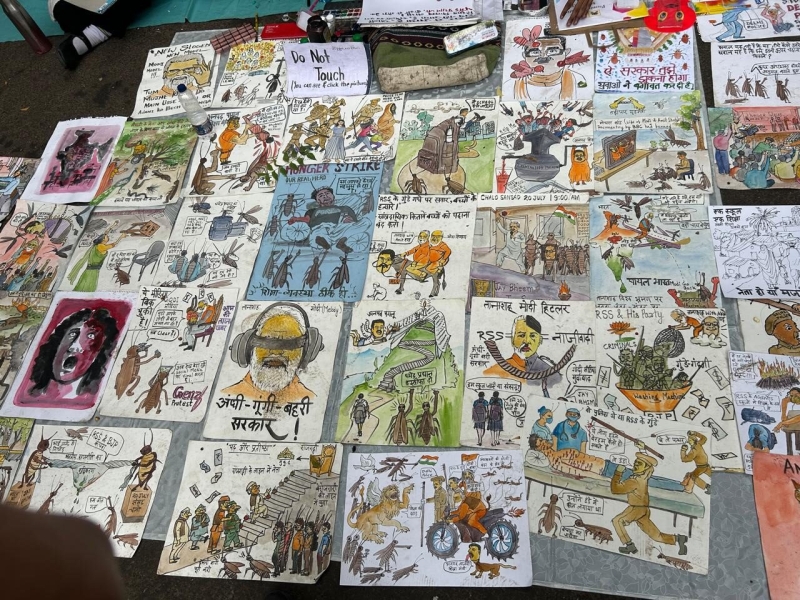
Student-made posters and artwork line the streets of Jantar Mantar, capturing messages of resistance and hope
After 50 days of protests at Delhi’s Jantar Mantar, India’s Union Education Minister Dharmendra Pradhan resigned on 25 July, marking a major moment for a youth-led movement that began as a satirical online campaign but evolved into a nationwide call for education reform.
The movement started in May as a satirical social media page called the Cockroach Janta Party (CJP), founded by Abhijeet Dipke after Chief Justice of India Surya Kant used the term “cockroaches” during a Supreme Court hearing, reportedly referring to people holding fake law degrees. The remark triggered widespread public criticism and inspired the creation of the online campaign.
Weeks later, allegations of a NEET-UG paper leak and irregularities in the Central Board of Secondary Education’s on-screen marking process transformed the satire into a broader protest movement.
On 6 June, Dipke called for a sit-in demonstration at Jantar Mantar, demanding Pradhan’s resignation. However, as the protest entered its seventh week, its focus expanded beyond one minister, with demonstrators raising concerns over paper leaks, administrative failures, examination transparency and the growing privatisation of education.
From Student Protest to Nationwide Movement
The protest site at Jantar Mantar became a gathering place for students, farmers, parents, young professionals, senior citizens, queer activists and workers from different parts of India.
Volunteers provided food, arranged travel support for protesters and coordinated donations. People travelled from across the country, while some foreign nationals also joined in solidarity.
Despite their different backgrounds, protesters shared a common concern — the future of India’s public education system.
The scale of frustration was reflected in examination-related figures. India recorded 152 examination paper leaks over the past decade, according to reports, while millions of students continue to compete for limited educational and employment opportunities.
In 2026, more than 20 million candidates appeared for NEET-UG, while reports of irregularities were followed by the deaths of nearly 20 aspirants by suicide.
According to the State of Working India 2026 report by Azim Premji University, nearly 40 per cent of graduates aged 15–25 remain unemployed, while unemployment among graduates aged 25–29 stands at 20 per cent.
Wangchuk’s Hunger Strike Becomes Turning Point
As the movement gained momentum, it attracted support from opposition leaders, public figures and education reform advocates.
The turning point came on 28 June, when education reformer Sonam Wangchuk joined the sit-in and began an indefinite hunger strike.
The Cockroach Janta Party later announced a march to Parliament on 20 July, the opening day of the Monsoon Session.
However, on 18 July, Delhi Police removed Wangchuk from the protest site and admitted him to Safdarjung Hospital for medical observation. His family described the move as forced hospitalisation against his wishes.
Two days later, police and the Rapid Action Force dispersed protesters attempting to march towards Parliament. Demonstrators alleged that authorities used batons, tear gas, water cannons and pellet guns during the operation.
The crackdown intensified public attention on the movement rather than ending it, with more people joining the protest at Jantar Mantar.
Protesters Demand Wider Education Reforms
Nineteen-year-old Anshil Khan, a first-year student at Delhi Skill and Entrepreneurship University, returned to the protest despite suffering injuries during the police action.
“I got hit three times by the Delhi police,” he said, adding that he had returned after resting for several days.
He said the movement was no longer only about one minister’s resignation.
“Dharmendra Pradhan’s resignation is the first step. Education is our first priority,” he said.
Many protesters echoed the same message, arguing that deeper reforms were needed to restore trust in India’s education system.
Nazia Khanam, a law student from Jodhpur who joined the demonstration while interning in Delhi, said she came to support students despite not personally being affected by an examination scandal.
“As an elder sister of a student who is going to give a competitive exam, it becomes my responsibility,” she said.
She called for stronger checks and balances in examination agencies and greater involvement of educators in policy-making.
“There should be other stakeholders involved. Educators who have done actual groundwork and understand the reality should be part of consultations,” she said.
Support Beyond Student Groups
The movement also attracted support from farmers’ organisations and civil society groups.
Ashutosh Agarwal, National Vice-President of the Bharatiya Kisan Union’s youth wing, joined the protest with colleagues from western Uttar Pradesh.
“We demand one nation, one education,” he said, calling for an end to the privatisation of education and healthcare.
He argued that increasing commercialisation had weakened public institutions and contributed to unequal access to quality education.
Parents also joined the movement, raising concerns about examination rules and the pressure faced by students.
Alisha Siddique, a mother of three children, said the education system needed to become more student-friendly.
“If students reach one or two minutes late because of an accident or emergency, they are not allowed to sit for the exam. Their entire year’s hard work goes to waste,” she said.
A Symbol of Wider Frustration
Avinash Kumar, a human rights practitioner and former Executive Director of Amnesty International India, said the examination crisis became a trigger for broader public frustration.
“The constant leaking of competitive exams provided that cause. Yet everyone knows it is now not just about that,” he said.
According to Kumar, the movement reflected concerns over declining public services, rising costs, increasing privatisation, shrinking civic space and growing dissatisfaction with institutions.
“You need a cause which cuts across classes and masses, age and gender and religion,” he said. “Competitive exams became that cause.”
He said the movement was notable because it did not depend on a single organisation or political leader.
“It is a movement with very different leaders at different points of time,” he said.
Questions Remain After Resignation
Two days after the minister’s resignation, the protest site at Jantar Mantar became almost empty.
However, the issues raised during the 50-day movement remain unresolved.
For many protesters, the resignation of one minister was only the beginning. They continue to demand greater accountability, transparent examinations, stronger public education systems and reforms that can restore young Indians’ confidence in their future.