

- One killed, two injured in attack at Ctg meeting over marriage |
- Dhaka ranks world’s third worst in air quality Saturday |
- Sylhet residents endure mosquito invasion amid dengue surge |
- Lioness brought back to Zoo cage after one hour of escape |
- Resumption of US Tests May Trigger Threats from Other Nuke Powers |
Sylhet residents endure mosquito invasion amid dengue surge
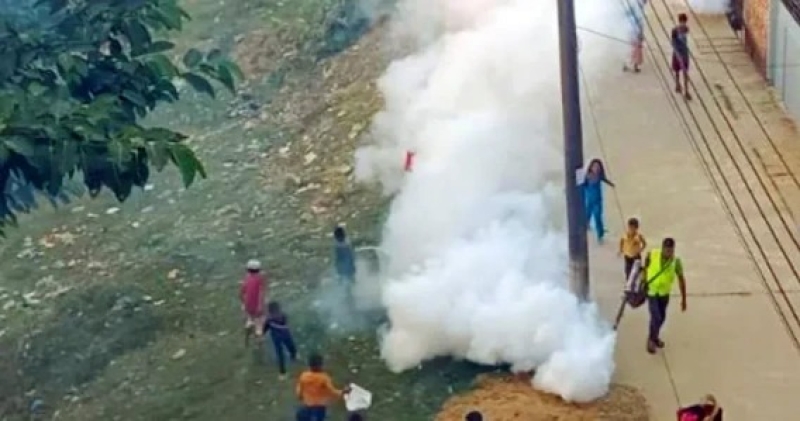
A Sylhet City Corporation worker spreading insecticides to control the spread of mosquity in the city._11zon
Sylhet, Dec 6 - Residents across Sylhet City Corporation (SCC) are struggling with an unrelenting mosquito infestation, facing bites day and night with little respite even inside their homes.
The worsening situation has reignited concerns over a potential spike in dengue cases during the winter months.
Despite SCC spending crores of taka every year on mosquito-control programmes, residents say the efforts have produced no visible improvement, prompting serious questions about the effectiveness of the city authority.
According to SCC data, Tk 2.26 crore was allocated for mosquito eradication in the fiscal year 2025–26 — the same amount spent in the previous fiscal year.
The funds were used to purchase 4,000 litres of larvicide (Temephos 50 EC) and 25,000 litres of adulticide (Malathion 57 EC) from the Bangladesh Machine Tools Factory. Yet residents insist the services remain grossly inadequate.
Many complain that fogging machines appear on the streets only occasionally — sometimes just once or twice a year — leaving several neighbourhoods completely untouched.
The organisation does not have a permanent mosquito-control workforce and instead relies on daily wage earners hired seasonally.
While officials maintain that 30–40 workers are deployed regularly, citizens argue that the efforts make little difference.
As the mosquito menace intensifies, dengue infections are also creeping up in Sylhet.
Two people have died of dengue this year, and new cases are being reported every day.
Although SCC claims most of the infected patients are from outside the city, anxiety among residents is rising.
At the Central Shaheed Minar area, college student Sumon Shawon said even standing outdoors in the evening has become unbearable.
“We came here for a chat but within minutes the mosquitoes swarmed us. It’s impossible to sit or talk,” he said, calling for urgent larvicide treatment of drains and stagnant water.
Apu, a resident of ward No-17, echoed the frustration, saying the situation is fuelling widespread fear.
“There’s fever and cold everywhere. We can’t even tell which is dengue and which is normal flu. Mosquito bites are leaving rashes and allergies, causing more illness,” he said.
SCC’s Chief Health Officer, Dr Md Zahidul Islam, admitted the crisis in manpower.
He said around 45 mosquito-control workers and seven supervisors are engaged daily, but the number falls far short of requirements. Ideally, each ward should have four to five workers and a supervisor.
With 42 wards under its jurisdiction, SCC would need more than 200 staff — a capacity the organisation cannot afford due to financial constraints.
He said although SCC has recommended permanent recruitment since 2021, various complications have stalled progress.
Dr Zahidul pointed out that instead of the monthly insecticide treatments recommended for effective control, the city manages to spray only two to three times a year, resulting in minimal, short-lived benefits.
Emphasising the role of public awareness, he said complete mosquito control is impossible without active citizen participation.
“If people cooperate, even one or two planned operations a year would be enough. Otherwise, the large amount spent on insecticides will simply go to waste,” he warned.
As of 4 December this year, Bangladesh has recorded 394 deaths from dengue nationwide.
During the same period, the Directorate General of Health Services (DGHS) registered 96,627 dengue-affected cases. - UNB