

- UN Assembly Urges Decisive Action to Resolve Israel-Palestine Conflict |
- Sediment-borne fertility transforms northern Bangladesh |
- 3 Armed Forces Chiefs, Jamaat Ameer visit Khaleda Zia at Hospital |
- Army, Navy, Air Chiefs Visit Khaleda Zia at Dhaka Hospital |
- EU, BDRCS, IFRC Partner to Strengthen Recovery of July Uprising Survivors |
Cold, power cuts and displacement haunt Ukrainians this winter
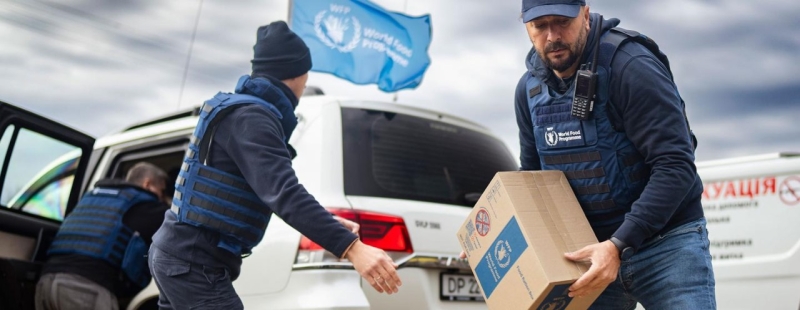
Emergency food supplies are distributed in Kryvorizhzhia, in the Donetsk region of Ukraine.
As Ukraine enters its fourth winter under full-scale invasion, millions of civilians face renewed hardship from relentless attacks, widespread power outages, and freezing temperatures, straining an already exhausted population.
Ongoing strikes on energy infrastructure have left communities uncertain about access to heat, electricity, and clean water in the coming months, while fresh displacement continues along active frontlines.
Humanitarian agencies warn that this winter could be among the most difficult yet, as intensified bombardment, worsening access constraints, and growing funding gaps threaten to leave hundreds of thousands without adequate support.
The psychological toll of nearly five years of conflict is also becoming more visible across the country.
Matthias Schmale, the UN Resident and Humanitarian Coordinator in Ukraine, highlighted the mounting winter risks, the deepening vulnerability of civilians, and the funding shortfall facing the relief response, while noting the resilience he witnesses daily.
Key Concerns
“The ongoing military strikes continue to have a direct and deadly impact on civilians,” Schmale said, citing recent casualties in Dnipro. He warned that destruction of energy infrastructure could leave thousands in high-rise buildings without heating, electricity, or water—a nightmare scenario if temperatures drop sharply.
Low-income urban residents, people near the frontlines, and the most vulnerable internally displaced persons (IDPs) are at greatest risk. Many IDPs remain in precarious conditions, unable to find adequate housing or employment.
Humanitarian Challenges
Winter worsens all risks. Road conditions deteriorate with snow and ice, and frontline convoys delivering food, water, hygiene items, and heating supplies face greater hazards. Shifting frontlines also limit access to communities, leaving tens of thousands beyond aid reach.
Schmale emphasised the importance of working with local authorities: Ukraine remains a functioning state, delivering essential services under extraordinarily difficult conditions. The UN and over 400 NGOs complement these efforts, filling critical gaps.
Winter Assistance Plan
The UN’s winter plan aims to reach 1.7 million people, primarily in rural areas and near frontlines. Aid includes cash for heating, warm clothing, and essential non-food items. The plan is currently 65% funded, with $278 million requested. Funding gaps mean some people may still struggle for adequate support.
“If the worst-case scenario occurs—people stuck in high-rise buildings without utilities—population movements will be inevitable,” Schmale warned.
Message to Ukrainians and the World
To Ukrainians: “We are determined to stay and deliver assistance through thick and thin.”
To the international community: “Generosity so far has saved countless lives, but the war is not over. Continued support is vital.”
Stories across Ukraine show both the resilience of its people and the heavy psychological toll of war. In Kharkiv, Kherson, and Mykolaiv, civilians adapt daily to destruction, occupation, and loss, demonstrating extraordinary courage and endurance amid immense grief.