

- 136 new drugs in 195 essential drugs list, pricing guidelines |
- BSF halts overnight road building near border as BGB intervenes |
- U.S. Pullout From Global Bodies Sparks Widespread Alarm |
- DU Syndicate for renaming Sheikh Mujib Hall after Osman Hadi |
Ensuring minority rights key to a civilised state: Speakers
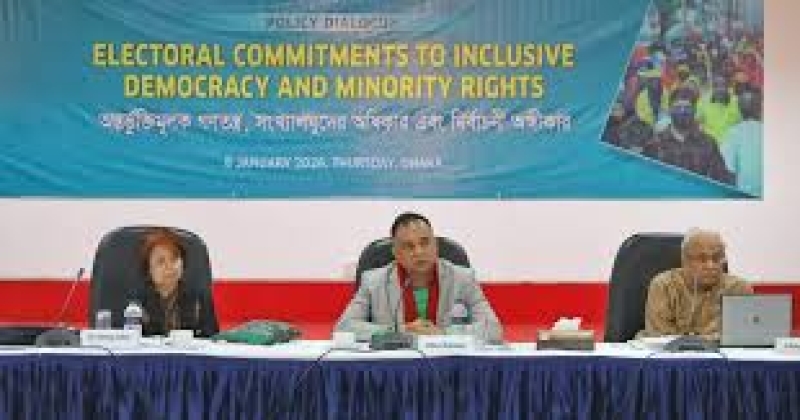
A state cannot be regarded as civilised unless it ensures the rights and protection of minorities and vulnerable groups, speakers said at a programme held on Thursday.
“Minority safety determines the quality of democracy,” they said at a policy dialogue titled “Electoral Commitments to Inclusive Democracy and Minority Rights” organised by The Centre for Governance Studies (CGS) at the auditorium of CIRDAP (Centre on Integrated Rural Development for Asia and the Pacific) in Dhaka.
Political leaders, civil society representatives, academics, lawyers, and human rights activists participated in the dialogue.
In the context of the upcoming national election, the discussion focused on the extent to which inclusion, minority rights, and democratic values are reflected in political parties’ electoral manifestos and political narratives. CGS President Zillur Rahman moderated the event.
Dr. Rounaq Jahan, Distinguished Fellow of CPD and political scientist, said that the quality of a democracy is partly determined by how safe and included minority communities feel. What matters is whether minority identities are imposed from outside or defined by the communities themselves.
“If individuals or groups do not wish to identify as minorities, that label cannot be imposed upon them,” she said.
She cited women as an example of this complexity, noting that although women are a demographic majority, they are often treated as a minority in terms of political representation and electoral power. While manifestos frequently include commitments to inclusion and equal rights, she stressed that these must be clearly documented, accompanied by realistic timelines, and followed by measurable implementation.
Dr. Badiul Alam Majumdar, Secretary of SHUJAN, said that inclusive democracy must be clearly reflected in electoral manifestos. A state cannot be considered civilized if the rights of minorities and vulnerable groups are not ensured. He emphasized that voter inclusion, fear-free voting, and transparent electoral processes form the foundation of inclusive democracy.
Mominul Amin, Secretary General of the Nationalist Democratic Movement (NDM), stated that the term “fascism” began to be widely used in Bangladesh after the 2009 election and has re-emerged in discussions in the context of political repression and the events of July. However, he emphasized that labeling any individual or party as fascist should be determined through judicial processes.
Sayeed Ferdous, Vice-Chancellor of Bangladesh Open University, stated that there is an inherent crisis within the nation-state itself, and imagining Bangladesh solely as a Bengali state marginalizes non-Bengali and minority communities.
He noted that since 1971, minorities defined by religion, ethnicity, gender identity, and class have faced continuous marginalization, which is directly linked to electoral processes.
Ho Chi Minh Islam, Trans Feminist and Gender and Sexual Rights Activist, said that the identity he carries remains socially contested, with no clear state-level recognition or decision.
He recalled that people of diverse identities, including hijra and third-gender individuals, participated in the 1971 Liberation War, yet were denied state recognition and rights after independence.
Rashna Imam, Advocate of the Supreme Court of Bangladesh, emphasized that realism and effectiveness are paramount when discussing electoral manifestos. Manifestos, she said, should not rely solely on aspirational language but must include realistic policies and clear implementation frameworks.
Former Member of Parliament Shamim Haider Patwary of the Jatiya Party (JP) said that problems cannot be resolved through statistics alone; pluralistic perspectives and the voices of minorities must be given due importance.
He emphasized the need for targeted and specific measures for minority communities, including parliamentary quotas for third-gender communities, the removal of structural barriers, and the establishment of a Minority Commission.
Among others, Ahsanul Mahboob Zubair, Assistant Secretary General of Jamaat-e-Islami; Mostafizur Rahman Faisal, Joint Secretary General of Khelafat Majlis; Nazmul Haq Prodhan, General Secretary of Jatiya Samajtantrik Dal (Jasad); Professor S. M. Shameem Reza of the Department of Mass Communication and Journalism, University of Dhaka; Sanjeeb Drong, General Secretary of the Bangladesh Indigenous Peoples Forum (BIPF); Sheikh Fazle Bari Masud, Joint Secretary General of Islami Andolan Bangladesh; Advocate and BNP leader Shihab Uddin Khan; Subrata Chowdhury, General Secretary of Gano Forum; labor leader and rights activist Taslima Akter; and Uzzal Azim, Programme Manager of Kapaeeng Foundation, also spoke, reports UNB.