

- অতিথি পাখির বিচরণ আর দুষ্টুমিতে নান্দনিক হয়ে উঠেছে কুয়াকাটার চর বিজয় |
- Remittance inflow exceeds $632 million in first six days of Dec |
- 18 migrants die as inflatable boat sinks south of Greek island of Crete |
- TIB for polls manifesto vows to curb misuse of powers and religion |
- Khaleda now not fit for travelling: Medical Board |
Law, Policy Reforms Needed to Fully Ban Child Labour
Nearly 3.5 million children in Bangladesh remain engaged in labour, with over one lakh of them involved in hazardous work, and an overwhelming 99 per cent still fall outside legal protection despite recent labour law reforms.
The reason, experts say, is that the vast majority of these children work in the informal sector, where legal safeguards are weakest.
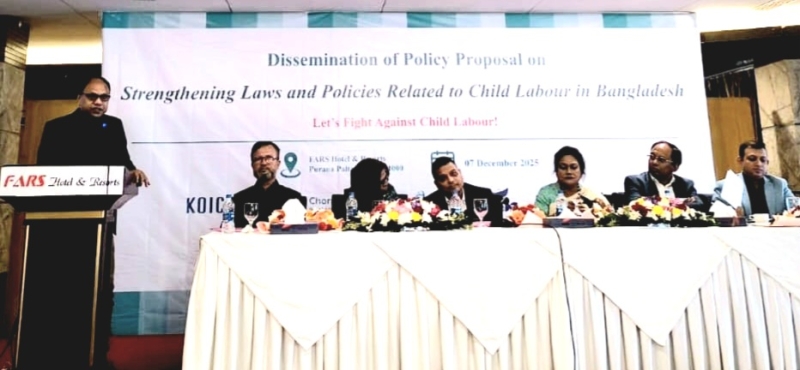
These observations were made by Prof Dr Md Nazmuzzaman Bhuiyan, of University of Dhaka, while presenting the keynote paper at a policy-sharing event on strengthening child labour–related laws and policies in Bangladesh.
The function was held on Sunday at a hotel in Dhaka, organised by Educo Bangladesh and the Child Labour Elimination Platform (CLAP). Educo Bangladesh Manager Afzal Kabir Khan presided over the session, which was moderated by Bangladesh Labour Foundation (BLF) Executive Director AKM Ashraf Uddin.
Senior officials and rights advocates, including Labour Ministry Joint Secretary Mohammad Mozammel Haque, Child Labour Monitoring Council Co-chair Advocate Salma Ali, Bangladesh National Women Lawyers’ Association (BNWLA) President Advocate Seema Zahir, and Educo Bangladesh Programme Director Abdur Rahim, also spoke at the event.
In his presentation, Dr Bhuiyan highlighted the current state of child labour, gaps in existing laws and policies, and crucial interventions needed to eliminate the practice. He noted that the amended Labour Act does not set any minimum wage for workers in the informal sector, where 99 per cent of child labourers are employed.
He recommended introducing a national minimum wage for children and adolescents working in both formal and informal sectors.
Dr Bhuiyan further pointed out that the National Plan of Action (NPA) for eliminating child labour expired in 2016 without achieving its targets. The latest National Education Policy extends compulsory education from Class 5 (age 10) to Class 8 (age 14), but the law must be amended to activate this policy. Until then, he warned, children aged 11 to 14 remain the most vulnerable to the worst forms of child labour, often in activities harmful to their health and safety. He stressed the need for greater public awareness and behavioural change to eradicate child labour.
Labour Ministry Joint Secretary Mohammad Mozammel Haque described child labour as one of the country’s major social challenges. Despite efforts from both government and non-government organisations, many children are still compelled to work for survival. He said the government is strongly committed to ending child labour and has been working to implement the NPA.
He expressed hope that necessary amendments to relevant laws and policies will be undertaken to strengthen ongoing efforts.