

- Body of Osman Hadi Returns to Dhaka From Singapore Late |
- Fakhrul condemns attacks on media, calls for unity, justice |
- 2 cops among 4 hurt in clash outside Indian Assit H.C. in Ctg |
- Inqilab Moncho urges people to avoid violence |
- Hadi’s death: Prothom Alo, Daily Star offices set afire |
Graffiti chronicling of July Uprising adorn Dhaka Metro pillars
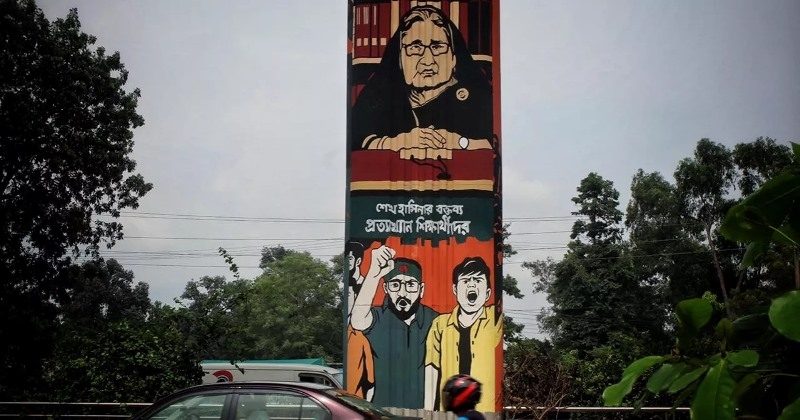
Graffiti on a Dhaka Metro pillar. Photo Tahiyat Nazifa Noor - UNB
A series of graffiti portraying last year's July Uprising has transformed the pillars of Dhaka Metro Rail from Karwan Bazar to Agargaon into visual timelines of resistance.
Initiated by LGRD, Youth and Sports Adviser Asif Mahmud Shojib Bhuiyan, the graffiti campaign traces key moments of the anti-discrimination students movement leading up to the fall of the government last July.
The art project was formally inaugurated on Saturday, August 2, at a ceremony organized by Dhaka North City Corporation at the Bijoy Sarani Metro Rail Station premises.
Graffiti - Student demonstrators brave repressive measures. Photo Tahiyat Nazifa Noor - UNB
LGRD, Youth and Sports Adviser Asif Mahmud Shojib Bhuiyan joined as the chief guest at the event. “These graffiti pieces will constantly remind us of the dark days of the Awami regime and the people's courageous resistance. They will play a crucial role in ensuring that no autocracy can ever rise again in this country,” he stated.
Spanning several metro pillars on Karwan Bazar, Farmgate, Agargaon and Bijoy Sarani, the artworks capture a timeline of political repression, public dissent, and pivotal events over the past 16 years, alongside the significant memories from last July. Among the incidents depicted are the BDR massacre at Pilkhana, the eviction of former Prime Minister Khaleda Zia from her cantonment residence, the stock market crash, enforced disappearance of Ilias Ali, the Shapla Chattar crackdown, the Holey Artisan attack, and the Reserve heist.
Other artworks address themes such as state-sponsored violence, question paper leaks, the imprisonment of Khaleda Zia, the safe roads movement, draconian laws, mismanagement during the Covid-19 pandemic, excessive spending during Mujib Borsho, the energy crisis, and the murders of Abrar Fahad and Ekramul Haque. Social and communal issues such as the Nasirnagar attacks, Tonu’s rape and murder, the killing of Biswajit Das, and the killing of Felani Khatun at the border are also powerfully portrayed.
A group of student volunteers worked over several days to paint the images on the pillars, blending art with activism to create a moving narrative of national resistance.
“Graffiti was one of the most powerful weapons of the revolution last July,” Mohtarima Noor, a private university student, told UNB. “These artworks not only enhance the metro pillars visually but also serve as vivid reminders of the turbulent times we’ve survived.”
The initiative has drawn significant public attention, transforming an urban transit corridor into a vibrant historical canvas that resonates with both memory and message. - UNB