

- ADP Implementation Hits Five-Year Low at 1.85% |
- NYC BNP leaders, activists upbeat ahead of Tarique Rahman’s arrival |
- PM off to New York to attend UNGA |
- 8 Killed in Ashulia Garment Factory Fire |
- Apratim Murder Suspects Confessed, Says Home Minister |
Funding Cuts Threaten Global HIV Prevention
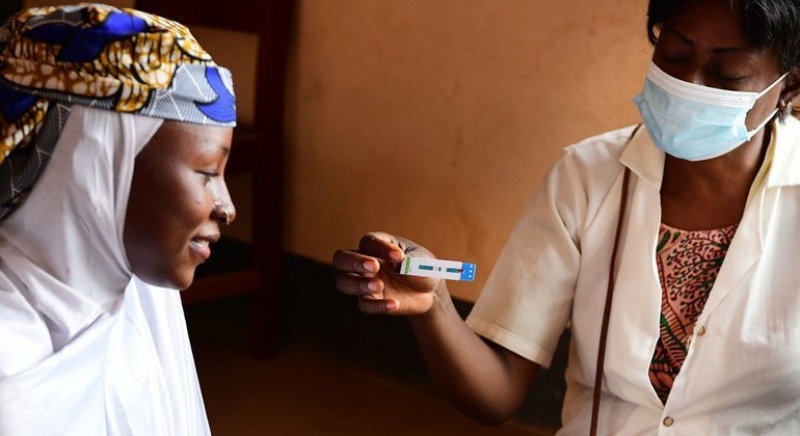
A 15-year-old girl taking an HIV test in Bertoua, Cameroon. (file)
High prices and funding cuts are threatening to reverse decades of progress in the global fight against HIV, with unequal access to breakthrough prevention medicines and a sharp decline in international financing raising fears of a resurgence of the epidemic, according to a UN report released on Monday ahead of the 26th International AIDS Conference in Rio de Janeiro, Brazil.
Why it matters
1.2 million people acquired HIV and 570,000 died from AIDS-related illnesses in 2025.
Twenty-two per cent of people living with HIV are still not receiving treatment.
International HIV funding fell by 18 per cent, the steepest decline in nearly two decades.
New medicines such as lenacapavir are nearly 100 per cent effective at preventing HIV infection.
Around 20 million people need access to antiretroviral-based prevention to significantly reduce the epidemic.
Generic versions of lenacapavir could cost as little as $40 per person per year, but they remain unavailable in many countries.
Defined by a paradox
The conference, taking place in Rio from 27 to 31 July, is defined by a striking paradox.
By the end of this decade, more than three million people could become infected with HIV, even though the tools needed to stop the epidemic already exist. From groundbreaking prevention medicines to proven community-led interventions, the scientific advances are available. What is lacking is sustained financing.
According to the new UNAIDS report, this widening funding gap is already forcing countries to cut essential services and shut down community organisations. Unless urgent action is taken, the agency warns, the world risks a resurgence of the epidemic.
That contradiction defines this year's conference.
On one hand, a revolution in HIV prevention is underway, with a new generation of medicines offering protection against HIV that is comparable to a vaccine.
On the other, there is growing concern that these breakthroughs will remain out of reach for millions because of their high prices and the restrictions imposed by pharmaceutical patent holders.
Brazil excluded from generic production
Few countries illustrate this paradox more clearly than Brazil, the host of the conference.
Although Brazil played a key role in the clinical trials that helped bring lenacapavir to market, it was excluded from the list of countries authorised to manufacture lower-cost generic versions.
Lenacapavir is a long-acting injectable medicine that requires only two injections a year and is nearly 100 per cent effective at preventing HIV infection, according to the latest studies.
Universal access remains out of reach
"Equitable and universal access remains a distant reality for millions of people because of high prices and the exclusion of many countries from voluntary licensing agreements," said Variano Terto Jr., Vice President of the Brazilian Interdisciplinary AIDS Association (ABIA).
Speaking at a conference side event organised by the Community of Portuguese Language Countries (CPLP), he said patents on essential medicines have been "reinforcing monopolies and the privatisation of public knowledge."
ABIA recently published a study showing that Brazil could manufacture lenacapavir domestically for approximately $75 per patient per year.
By contrast, the patented version costs more than $20,000 per patient annually, a price considered unsustainable for Brazil's public health system.
Risk of injustice
The true measure of success is not whether medicines exist, but whether those who need them can obtain them at an affordable price, said UNAIDS Executive Director Winnie Byanyima.
"Innovation without access is not innovation; it is injustice."
UNAIDS estimates that 20 million people need access to antiretroviral-based prevention if the world is to significantly reduce new HIV infections.
Calls for a new funding model
Although HIV infections and AIDS-related deaths are at their lowest levels in more than three decades, the global response remains dangerously fragile.
International HIV financing fell by more than $1.5 billion between 2024 and 2025, an 18 per cent decline that brought funding to its lowest level in nearly two decades.
Global development assistance also fell by 23 per cent last year, marking the largest annual decline on record, with health programmes, including HIV initiatives, among the hardest hit.
Meanwhile, new HIV infections increased across three regions and in 21 countries during 2025.
Byanyima said the current moment should be seen as "the end of the era of dependence on international aid" and called for a new financing model, including measures such as sovereign debt restructuring, to enable governments to invest in "the future of their people."