

- WHO Warns Global Blood Shortages Put Lives at Risk Report |
- US Thrash Paraguay 4-1 in Dream World Cup Start |
- FY27 Budget Reflects Public Aspirations: Khosru |
- 3 Red Cards Mar Mexico vs South Africa World Cup Opener |
- Hwang In-beom inspires South Korea's 2-1 victory over Czech Republic |
Funding Cuts Threaten Global Fight Against HIV
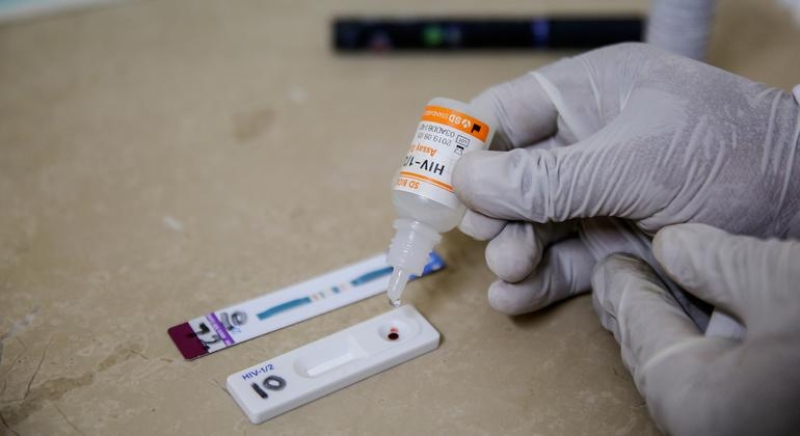
A lab technician conducts an HIV screening test at a medical centre in Hayatabad in the Peshawar district of Pakistan.
Global progress in the fight against HIV/AIDS is at risk of being reversed due to funding cuts, shrinking human rights protections, and chronic underinvestment in prevention and community services, a new UN report warned on Friday.
The report cautioned that hard-won gains made over decades could unravel if urgent action is not taken to restore support for HIV programmes and vulnerable communities.
“There’s no question that this is the most serious disruption in the HIV response since the world came together to fight this disease,” said Winnie Byanyima, Executive Director of UNAIDS.
According to the report, every week around 3,000 adolescent girls and young women in sub-Saharan Africa acquire HIV, highlighting the world’s failure to adequately protect some of the most vulnerable populations.
“The funding cuts, combined with the reduction in civic space and the further criminalisation of marginalised populations, have come together to create the biggest storm the HIV response has ever seen,” Byanyima said.
The report found that many people are struggling to access treatment while the virus continues to spread.
Global development assistance declined sharply in 2025, with funding from multiple countries dropping by 23 per cent — the steepest decline on record. HIV programmes were particularly affected, as testing services in high-burden settings fell by 22 per cent between 2024 and 2025.
In some countries, funding for condoms dropped by more than 90 per cent. Meanwhile, uptake of PrEP, a daily medicine used to prevent HIV infection, fell by 38 per cent between 2024 and 2025 in 62 countries reporting to UNAIDS.
The report also highlighted setbacks in human rights, noting that criminalisation of marginalised populations increased for the first time since UNAIDS began monitoring these trends. In 2025, two countries introduced laws criminalising same-sex sexual activity, while another country increased penalties in 2026.
At the same time, HIV prevention efforts are weakening despite the emergence of new long-acting prevention technologies that could significantly reduce infections.
Prevention programmes were already underfunded, accounting for only 11 per cent of total HIV spending in 2024, and investment is continuing to decline with little indication that domestic financing will close the gap.
Despite the setbacks, the report stressed that the global HIV response remains one of the greatest public health success stories of the past quarter century.
AIDS-related deaths have fallen by 56 per cent, dropping from 1.3 million in 2010 to 570,000 in 2025. New HIV infections have declined by 43 per cent over the same period to 1.2 million, while 78 per cent of the 40.9 million people living with HIV are now receiving treatment.
However, the report warned that these achievements remain fragile, with nearly nine million people still lacking access to treatment.
A recent study of 79 community-led organisations across 47 countries found major disruptions to HIV-related support services. Community support services for people living with HIV dropped by 50 per cent, while services for sex workers declined by 82 per cent. Services for men who have sex with men were reduced by 85 per cent.
UNAIDS said the loss of funding is weakening trust, reach and effectiveness in HIV responses worldwide, even as infections continue rising in parts of Eastern Europe, Central Asia, the Middle East, North Africa and Latin America.
“We know how to end AIDS,” Byanyima said.
“The question now is political: will we invest or will we retreat?”
Looking ahead, countries are expected to adopt a new political declaration at the UN General Assembly’s High-Level Meeting on HIV/AIDS on 22 and 23 June, aimed at ending AIDS within the next five years.
The declaration will outline new 2030 targets, including expanding antiretroviral treatment to 40 million people, increasing access to HIV prevention medicine to 20 million people and ensuring healthcare services remain free from stigma and discrimination.
“If we follow the Global AIDS Strategy and UN Member States commit to adopting a strong political declaration to guide the response over the next five years, we can still end AIDS by 2030,” Byanyima said.
“However, if we fail to act, we risk reversing decades of hard-fought progress.”