

- Tarique Seeks Japanese Support for Energy, Tech and Infrastructure |
- Japan eyes 1 trillion yen investment in Bangladesh over 5 years |
- Dhaka Among World’s 11 Most Polluted Cities on Tuesday |
- Tide Rising, Time Running Out For Coastal People, Wildlife |
- Dhaka Turns To Solar As Fuel Crisis Turns Power Plants Idle |
Tide Rising, Time Running Out For Coastal People, Wildlife
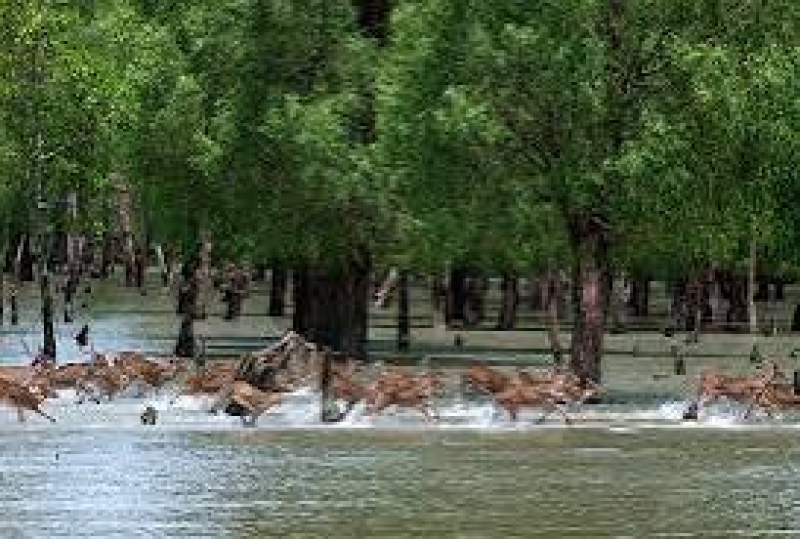
Sundarbans spotted deer caught in a life-threatening tide. Photo Collected.
Special Correspondent
DHAKA – Twice a day, the calm of the world’s largest mangrove forest is shattered. As the brackish waters of the Bay of Bengal surge into the narrow canals and creeks of the Sundarbans, an unequal, silent struggle for survival begins. It is a battle fought not just by the iconic Royal Bengal Tiger or the herds of spotted deer, but also by millions of resilient human lives anchoring the exposed coastline of southwest Bangladesh. Driven by climate change, accelerating sea-level rise, and increasingly fierce cyclonic storms, the rising tides have blurred the boundaries between the perils of nature and the endurance of humanity.
In the deep wilderness, locals call the first daily surge of tidal water ‘pali’. It is a terrifying moment for the forest’s more vulnerable inhabitants. Newborn spotted deer fawns and herds of wild boar, unable to swim well enough to hold their ground, are frequently swept by the rapid currents into main river channels where hungry estuarine crocodiles roam for haunts. Tides on new-moon and full-moon nights—the spring tides—are the most treacherous. Geckos, monkeys, and wild birds asleep in the dark canopy are caught off guard by sudden flooding. Seeking higher ground at night is a perilous gamble. As the forest floor disappears under three to five feet of water during abnormal low-pressure systems, the entire ecosystem enters emergency mode.
During these high tides, the Royal Bengal tigers reveal their prowess as expert swimmers, moving miles against the current from one island to another. Yet even their resilience has limits. As the land area shrinks, the apex predators are forced onto artificial earth mounds known as ‘kellas’, crowding alongside hundreds of deer and boars. Here, with more animals than the mounds can hold and little food, an uneasy truce gives way to a brutal crisis of territory. Each tiger fiercely marks its domain with urine and bark scratches, but climate change is constricting these borders.
When the tide recedes, the greatest struggle begins: the search for fresh water. The Sundarbans’ rivers are highly saline, leaving animals dependent on a few natural and man-made freshwater ponds. When a storm surge enters these ponds, the water turns saline. "The animals cannot drink, no matter how thirsty they are," notes a local field tracker. "Until the sky breaks into rain, they must simply endure." The crisis reached a devastating peak during Cyclone Remal in May 2024, when the Sundarbans remained submerged under an 8-to-12-foot storm surge for 36 hours. In the aftermath, the Forest Department recovered 134 dead deer within seven days, while 80 freshwater ponds were contaminated with saltwater, triggering an acute drinking water crisis for both wildlife and forest staff.
Just across the shifting river boundaries, the human cost of this rising tide is equally harrowing. For the coastal communities of Satkhira, Khulna, and Bagerhat, the Bay of Bengal is no longer just a source of livelihood; it is a permanent threat to their existence. "We live with one eye on the river and the other on the sky," says Abdul Majid, a 52-year-old fisherman from Gabura Union in Shyamnagar, Satkhira. "The embankments that protect our homes are fragile. When the full moon tide hits, the water licks the very top of the mud walls. We don't sleep those nights. If the embankment breaches, our homes, our shrimp ghers (enclosures), and our lives are swept away before dawn."
For these communities, the intrusion of saltwater has systematically destroyed traditional agriculture. Fields that once yielded bountiful harvests of rice are now barren, encrusted with white salt crystals. Forced to adapt, many turned to shrimp farming, but even this has become volatile as extreme tides wash away the enclosures overnight. With agriculture dying, thousands of coastal men and women risk their lives daily by entering the core zones of the Sundarbans. Known as Bawalis (golpata gatherers), Moualis (honey collectors), and traditional fishermen, they navigate the deep canals where tigers and crocodiles hunt. This human influx further complicates the ecological crisis; frightened wildlife, disturbed by the noise of motorboats and gatherers, often flee deeper into high-risk tidal zones.
The domestic drinking water crisis mirrors that of the wildlife. Rice fields and local ponds are severely salinised. Women are forced to walk three to four kilometres daily just to collect a pitcher of potable water from solitary filtration plants. "Our young women are suffering from severe reproductive health issues due to the mandatory use of saline water for daily chores," shares Rahima Begum, a community health volunteer in Dacope, Khulna. "The tide doesn't just take our land; it takes our health."
The harrowing experiences of locals and forest rangers are repeatedly validated by rigorous scientific research. A landmark joint study by Bangladeshi and Australian scientists (Sharif A. Mukul et al., 2019) delivered a stark warning: if current trends in climate change and sea-level rise persist, there will be no suitable habitat remaining for the Royal Bengal tiger in the Sundarbans by the year 2070. This backed an earlier 2010 WWF-led study by Colby Loucks and colleagues, published in Climatic Change, which estimated that a 28-centimetre rise in sea level above 2000 levels would reduce the tiger's mangrove habitat by 96 percent, collapsing the number of breeding adults to fewer than 20.
The loss of habitat directly fractures the food chain. A study led by Dr. Md. Abdul Aziz, a professor of zoology at Jahangirnagar University and a renowned tiger expert, reveals the delicate balance of the ecosystem. "Spotted deer account for about 78 percent of the biomass of the Sundarbans tiger’s diet," Dr. Aziz explains. "Tiger density is inextricably linked to deer density. If deer populations plummet due to habitat loss, severe tidal drowning, or nutritional stress from the top-dying disease of Sundari trees, the survival of our tigers is directly at risk."
To shield the Sundarbans’ biodiversity and its neighbouring human settlements from this climate onslaught, experts urge immediate, science-based intervention. First, the height of the artificial kellas inside the forest must be raised significantly to withstand abnormal storm surges, paired with the planting of salt-tolerant grasses to feed stranded herbivores. Concurrently, the banks of freshwater ponds must be elevated and reinforced with modern sluice gates that shut automatically during high tides to store fresh rainwater.
To mitigate human-wildlife conflict—which spikes when thirsty animals stray into villages—the installation of high-strength nylon fencing along sensitive forest boundaries is crucial. Furthermore, human entry into core wildlife breeding zones must be stringently regulated, and eco-tourism strictly managed to reduce acoustic pollution from speedboats. On the human side, the construction of climate-resilient, mega-embankments is non-negotiable. Rivers adjacent to the mangrove must be dredged systematically to clear accumulated silt, restoring their capacity to hold water and preventing prolonged, destructive waterlogging.
While local adaptation is underway, Bangladesh cannot solve this crisis alone. Bangladesh remains among the most vulnerable nations to climate change despite contributing negligibly to global carbon emissions. Bangladesh is demanding robust international action regarding climate justice, the operationalisation of loss and damage funds, and enhanced adaptation support. While the government has begun implementing localised resilience strategies, the international community must honour its financial commitments to help vulnerable deltaic nations survive.
The plight of the Sundarbans is a global canary in the coal mine. If the Royal Bengal Tiger vanishes and the coastal people of Bangladesh are driven out as climate refugees, it will mark an irreversible failure of global environmental stewardship. The tide is rising, and time is running out.