

- President Shahabuddin Set to Resign Today: Agency |
- Trade Deficit Widens 24% Despite Record Remittances |
- Modi Invites Tarique to BRICS Summit in India |
- Govt Moves to Bring ETPs Online to Save Buriganga |
- President Shahabuddin Eyes Resignation: Sources |
15.3 Million Face Acute Food Insecurity in Bangladesh
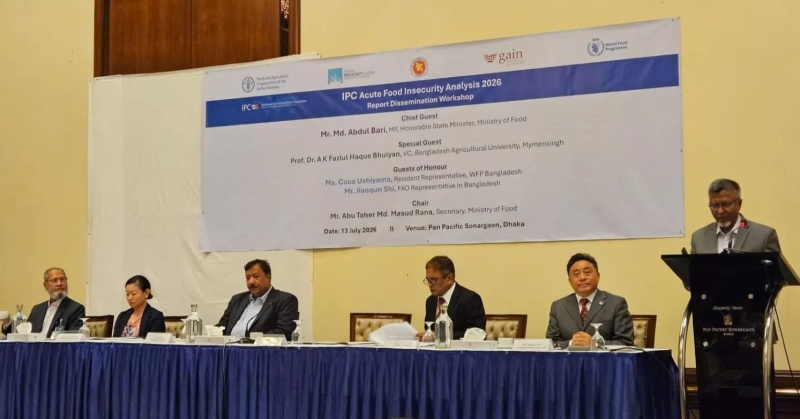
Approximately 15.3 million people in Bangladesh—about 15 percent of the analysed population—are facing high levels of acute food insecurity between May and August 2026, including around 483,000 people experiencing emergency conditions, according to a new analysis released on Thursday.
The situation is expected to worsen between September and December 2026, with the number of people facing acute food insecurity projected to rise to 18.1 million, including 787,000 in emergency conditions.
The findings were presented at a high-level dissemination workshop in Dhaka, jointly organised by the Ministry of Food and the Food and Agriculture Organization (FAO), the World Food Programme (WFP), Action Against Hunger, Save the Children, and the Global Alliance for Improved Nutrition (GAIN).
The workshop, led by the Food Planning and Monitoring Unit (FPMU) under the Ministry of Food, brought together senior government officials, UN agencies, development partners, academics, and civil society representatives to discuss the latest Integrated Food Security Phase Classification (IPC) Acute Food Insecurity Analysis for Bangladesh.
The analysis identified the Chittagong Hill Tracts, the Haor region, selected coastal districts, and Rohingya camps in Cox's Bazar and Bhasan Char as the areas facing the highest levels of acute food insecurity.
State Minister for Food Md Abdul Bari said Bangladesh remains committed to using evidence-based analysis to guide policies and investments that strengthen food security and resilience.
"The IPC findings will help us target resources more effectively and reinforce our collective efforts to support vulnerable communities facing increasing climate and economic pressures," he said.
Food Secretary Abu Taher Md Masud Rana stressed the importance of evidence-based policymaking, expressing hope that the report would help policymakers, development partners, and humanitarian organisations design more targeted interventions to improve food and nutrition security.
Secretary (Director General) of the NGO Affairs Bureau at the Prime Minister's Office Dr Mohammed Jakaria said achieving food security requires coordinated action across government agencies, NGOs, UN organisations, research institutions, and development partners.
According to the report, worsening food insecurity is being driven by adverse weather, floods, inflation, rising food and fuel prices, global supply chain disruptions, and broader economic challenges that have weakened household purchasing power.
Without timely interventions, these pressures are expected to further reduce access to sufficient and nutritious food for millions of people.
Participants at the workshop recommended expanding emergency food assistance, strengthening shock-responsive social protection programmes, promoting climate-resilient agriculture, supporting livelihood recovery, and investing in disaster preparedness and early warning systems.
FAO Representative Dr Jiaoqun Shi said strengthening climate-smart agriculture, sustainable livelihoods, and local food production is essential not only to address immediate food insecurity but also to protect vulnerable communities from future climate shocks.
WFP Representative and Country Director Coco Ushiyama said the IPC analysis helps identify communities most at risk before crises deepen, enabling more effective targeting of assistance. She noted that many of the most vulnerable areas are currently experiencing heavy rainfall and flooding, particularly in the Chittagong Hill Tracts, where WFP has activated anticipatory action and supported the government's shock-responsive social protection efforts.
The Ministry of Food and its partners reaffirmed their commitment to working together to address immediate food security needs, strengthen resilience to future shocks, and support Bangladesh's long-term food security goals.