

- Iran dismisses Trump’s threats, vows swift response to any US attack |
- Student-led shrimp farming sparks rural aquaculture boom in Naogaon |
- Bangladesh Sets Path for Sustainable Farming by 2050 |
- Child rescued from deep tube-well hole in Ctg dies |
- Days ahead will be very challenging for journalists' - ABM Mosharraf |
Student-led shrimp farming sparks rural aquaculture boom in Naogaon
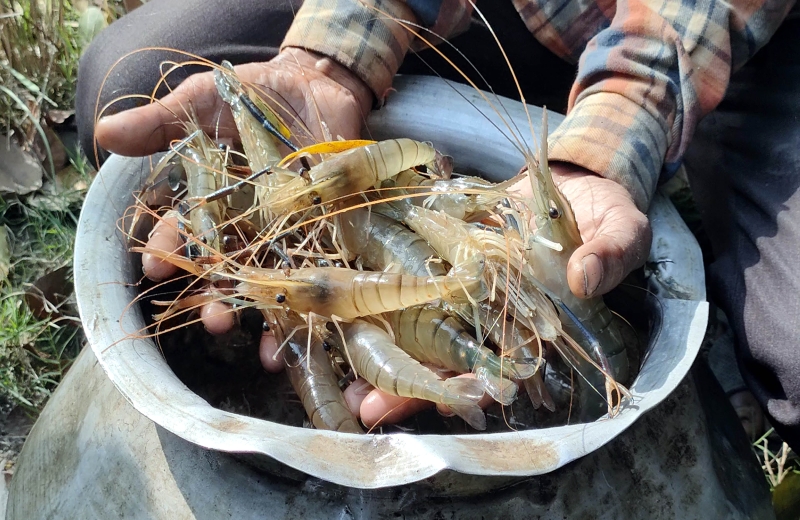
Successful shrimp farming led by students in Naogaon. UNB
By SM Ashadur Rahman. Naogaon, Jan 29 - What started as an experiment in a single pond in Naogaon is emerging as a model for rural innovation, showing how careful management and mixed farming methods can redefine livelihoods in Bangladesh’s remote districts.
Traditionally known for carp and other freshwater fish, Naogaon is witnessing the first successful cultivation of giant freshwater shrimp, or galda chingri, a species mostly farmed in Khulna, in the district’s ponds.
Raju Sardar, a student and fish farmer in Dighirpar village of Sadar upazila, has drawn attention by integrating galda with carp species in his pond.
His approach, combining careful water monitoring, balanced feeding and regular pond maintenance, has encouraged other farmers to explore the high-value species.
Since Raju began the initiative, at least 30 to 40 farmers in and around the area have started cultivating galda shrimp using the mixed farming method.
Raju, who has long practised carp polyculture, said conventional methods yielded limited profits, prompting him to explore alternatives.
In June last year, he joined a demonstration programme titled ‘Giant freshwater shrimps farming under improved management’ conducted by a local development organisation’s agriculture unit.
He initially received 500 galda fry through the program and, undeterred by scepticism from others, invested in an additional 1,000 fry.
The integrated farming approach proved successful: within months, shrimps grew rapidly, with each kilogram now containing only seven to eight shrimps, a benchmark for freshwater cultivation.
Raju projects a harvest of 120 to 130 kilograms of galda shrimps, which could fetch between Tk 1.20 lakh and Tk 1.40 lakh at market rates of Tk 800–1,000 per kilogram. When combined with carp production, the mixed system nearly doubles income from the same pond.
Local fish farmer Saiful Islam said the initiative has shifted perceptions. “We never imagined that a species mostly farmed in Khulna could thrive in Naogaon. Raju’s pond has become a live training centre for farmers,” he said.
Farmers, encouraged by the market demand and prices, are now planning to expand shrimp cultivation.
Md Shahriar Hossain, Fisheries Officer at the development organisation’s agriculture unit, said the initiative is part of efforts to modernise the fisheries sector by introducing profitable species with low investment.
“Galda farming has been introduced in Naogaon for the first time. Its success has sparked interest in mixed farming, which has proven highly profitable,” he said.
Dr Md Bayezid Alam, Senior Fisheries Officer of Naogaon Sadar Upazila, described freshwater galda farming as a new chapter for the district’s fisheries sector.
“With proper management, galda can be cultivated even in small ponds. Wider adoption could boost employment, increase fish production, and strengthen the local economy,” he said, adding that training and technical support will be provided to interested farmers.
Raju Sardar’s success underscores the potential of innovative aquaculture in reshaping rural economies beyond Bangladesh’s traditional coastal hubs, he said. - UNB