

- ‘Very unhealthy’ air quality persists in Dhaka |
- Customs duty on dates imports cut ahead of Ramadan |
- NBR extends VAT exemption on Metro Rail services |
- People eagerly await Tarique Rahman's homecoming Thursday |
- Palm trees axed in Naogaon bypass for safety of electric line |
Palm trees axed in Naogaon bypass for safety of electric line
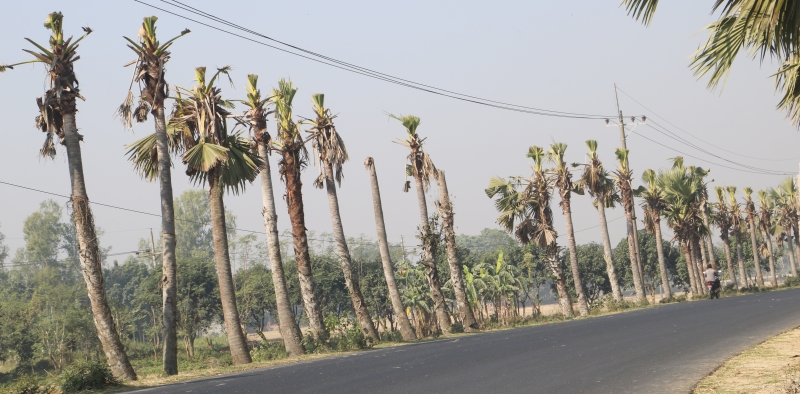
Palm trees axed in Naogaon for the safety of an electric line - misjudged action.
By SM Ashadur Rahman. Naogaon, Dec 24 - Along the Naogaon bypass road, tall palm trees once stood like silent sentinels—lining the highway, softening the concrete stretch with shade and symmetry, and serving a purpose far beyond aesthetics.
Today, many of those trees bear blunt, shaved tops, their branches cut back abruptly, leaving locals fearful that a decades-old natural shield is slowly being destroyed, locals and environmental activists said.
The cutting of branches from around 750 palm trees by the Northern Electricity Supply Company Limited (NESCO) has sparked anger and concern among residents and environmental activists, who say the work was carried out without consultation and with little regard for environmental consequences.
For years, villagers along the bypass—from Rambhadrapur to Battali Boalia—had planted palm trees using seeds collected from nearby areas. Most of the trees are now between 20 and 30 years old.
Over time, they transformed the two-kilometre stretch into a greener, cooler corridor, breaking the monotony of the road and offering protection against lightning, a known benefit of palm trees in Bangladesh.
But recent branch-cutting and top-shaving to accommodate electricity poles and overhead lines have changed the landscape dramatically.
During a recent visit to the area, the UNB correspondent observed that while several thousand palm trees stand along the stretch, around 750 have been visibly altered, with many appearing weakened. Residents fear the damage may be irreversible.
“It was not right for the electricity office staff to shave the tops of the palm trees,” said local resident Sakhawat Hossain, pointing towards several injured trees. “Some trees died after similar work before. Even when we protested, no one listened,” he said.
Another local resident, Belal Hossain, echoed the frustration. “Palm trees take decades to grow. The electricity staff cut the branches and shaved the tops in just one day. They could have moved the poles slightly to save the trees, but instead they damaged them deliberately,” he said.
Environmental activists say the issue goes beyond local inconvenience. Nice Parveen, an environmental activist in Naogaon, warned that cutting palm trees could increase lightning-related risks in the area.
“These trees are crucial for preventing lightning deaths. Cutting them puts lives at risk. On one hand, the government is encouraging tree plantation; on the other, state agencies are destroying mature trees. If this continues, we will be forced to launch a movement to protect them,” she said.
The criticism has put NESCO on the defensive. Responding to the allegations, Md Milan Mahmud, Executive Engineer of NESCO South, described the operation as routine and necessary.
“The branches and tops of risky trees were cut to ensure the safety of the 33,000-volt power lines,” he said, adding, “If trees come into contact with electric wires during storms, it could cause major disasters. This work is carried out every year to prevent such risks.”
Yet for locals, the explanation offers little comfort. They insist that safety and environmental protection should not be mutually exclusive—and that alternative measures, such as relocating poles or using insulated lines, could have preserved both electricity supply and the trees. - UNB