

- Around 7,500 Bangladeshis imprisoned in Saudi Arabia: Shama Obaed |
- Bangladesh Outperforms India in Global Hunger Index 2026 |
- Covered van hits Gazipur police patrol team, killing SI, BNP leader |
- Korean City scrambles to rescue dusky shark after it returns to canal |
- PM inspects Mongla Port, Sundarbans, proposed economic zone |
Bangladesh Seeks Predictable Global Finance for Climate Action
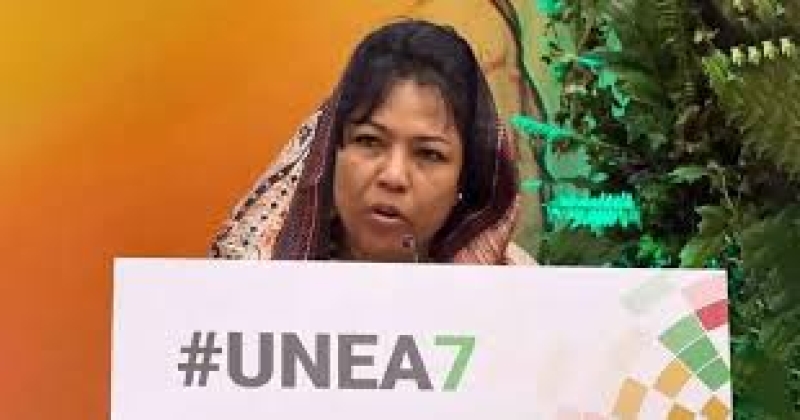
Bangladesh has urged the international community to deliver predictable and adequately financed support to confront the triple planetary crisis of climate change, biodiversity loss and pollution.
Dr. Farhina Ahmed, Secretary of the Ministry of Environment, Forest and Climate Change, made the call while presenting Bangladesh’s national statement at the plenary of the 7th United Nations Environment Assembly (UNEA-7) in Nairobi. Md Ziaul Haque, Additional Director General of the Department of Environment, attended as part of the national delegation.
Dr. Farhina warned that without sufficient financial resources and access to technology, climate-vulnerable countries struggle to meet growing environmental threats. She said limited national budgets force governments to divert funds from essential sectors such as health, education and social protection toward disaster response, putting future generations at risk.
She urged UNEA-7 to mobilize resources through multilateral environmental agreements in a coordinated and coherent way.
Highlighting the urgency of Bangladesh’s situation, she said climate change is a daily reality marked by extreme heat, cyclones, floods, sea-level rise and river erosion—hazards that displace millions and damage ecosystems. Despite contributing less than 0.5 percent of global emissions, Bangladesh continues to pursue ambitious climate actions.
She noted that Bangladesh’s enhanced NDC 3.0 aims to generate 25 percent of electricity from renewable sources by 2035—five times the current level. The country is also advancing its National Adaptation Plan (NAP 2023) and scaling up locally led adaptation efforts in vulnerable regions.
Addressing biodiversity loss, Dr. Farhina cited mounting pressure on natural resources in a densely populated nation of 180 million. She outlined ongoing implementation of the National Biodiversity Strategy and Action Plan (2026–30), the National Conservation Strategy, the Ramsar Strategic Plan (2026–30), and national targets on land degradation neutrality.
On pollution, she recalled Bangladesh’s pioneering decision to ban thin plastic bags and detailed further regulations on solid waste, e-waste, medical waste, hazardous waste and ship-breaking waste management. The country has finalized Extended Producer Responsibility (EPR) directives on plastic waste and restricted the use of selected single-use plastics. Draft Chemical Waste Management Rules have also been prepared.
She urged UNEA-7 to adopt an integrated lifecycle approach to chemicals and plastics that promotes prevention, safer alternatives and circularity while protecting informal workers.