

- EU calls for stronger borders after Ceuta migrant crossings |
- Iran warns of risks. casualties of blocade of its ports continues |
- PM issues three directives to boost solar power, tackle energy crisis |
- Worsening gas shortage threatens exports, disrupts daily life |
- A 20-metre road, eight months underwater in Kushtia |
GEF Pushes Green Finance Ahead of Key Assembly
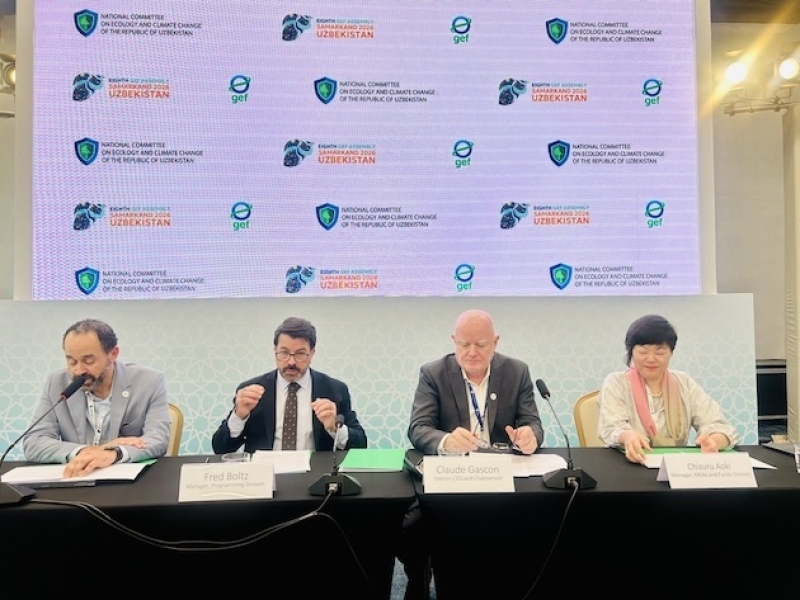
Alexandre Pinheiro facilitates a GEF press conference at the conclusion of 71st GEF Council in Samarkand, Uzbekistan. The conference was addressed by Fred Boltz, Manager, Programming, Claude Gascon, Interim CEO and Chizuru Aoki, Manager, MEAs and Funds Division.
As the Global Environment Facility (GEF) prepares to enter its next financial cycle, Interim CEO Claude Gascon has described the moment as one of “transition and delivery.”
He made the remarks during a press briefing on the eve of the Eighth GEF Assembly, which is scheduled to begin on June 4.
“We are reflecting on the strong results of GEF-8 while looking ahead to the next four years with the launch of GEF-9, which will have a sharper focus on impact, speed, and scale,” Gascon said.
The GEF-9 replenishment package, approved by the Council, will be presented at the Assembly and, according to Gascon, sends a strong message that “multilateral collaboration still matters.”
The remarks came as the 71st GEF Council concluded in Samarkand, Uzbekistan.
Donor countries pledged an initial USD 3.9 billion to help developing countries accelerate progress toward their 2030 environmental goals.
“The USD 3.9 billion represents an initial set of pledges,” Gascon said, adding that despite global fiscal pressures, “it is a very, very strong signal.”
He emphasised that discussions with donor countries remain ongoing.
“We are confident that over the next six to 12 months, we will secure significantly higher pledges,” he said, noting that additional commitments could be integrated into the GEF-9 financial framework as they materialise.
Chizuru Aoki, Manager of the Multilateral Environmental Agreements and Funds Division, pointed to upcoming global environmental meetings as likely opportunities for new commitments.
“We expect to hold pledging sessions during CBD COP17, as well as at other climate and desertification COPs,” she said. “These meetings are often important opportunities for new announcements.”
Blended Finance and Innovation
With public finance under pressure, the GEF is placing greater emphasis on blended finance and other innovative mechanisms to maximise limited resources.
Fred Boltz, head of the Programming Division, said such financial instruments are “very much in demand” and increasingly central to GEF operations, although they are not a substitute for core funding.
Gascon clarified how blended finance works within GEF operations.
“The blended finance the GEF provides is, in fact, grant funding that helps countries develop blended finance projects,” he said. “The GEF portion is not expected to be repaid by the country.”
He added that if projects fail, “the GEF money is essentially lost,” highlighting the institution’s role in absorbing risk to attract private capital.
“GEF funding can help lower interest rates or enable new technologies to be adopted,” Gascon said, explaining that such support makes projects commercially viable and encourages private-sector participation.
Examples of innovative financing include biodiversity-linked instruments such as species bonds, which allow private investors to support conservation efforts while tying returns to measurable outcomes, such as increases in wildlife populations.
Key Priorities Under GEF-9
The GEF-9 replenishment package introduces structural reforms aimed at making the institution faster, simpler, and more accountable.
Key priorities include:
Integrated programmes targeting transformation across nature, food, urban, energy, and health systems.
Blended finance at scale, with an aspirational goal of allocating 25% of resources to mobilise private capital.
Whole-of-government and whole-of-society engagement, strengthening participation by civil society, youth, women, and the private sector.
Enhanced support for vulnerable countries, with 35% of resources directed to least developed countries (LDCs) and small island developing states (SIDS), and 20% allocated to Indigenous Peoples and local communities.
GEF-9 will also allocate USD 100 million to an Indigenous Peoples and Local Communities Conservation Initiative—four times the amount provided during the previous funding cycle.
Aoki stressed that diversified financing approaches are intended to complement, not replace, traditional donor contributions.
Assembly to Shape Future Direction
The financing discussions come as the GEF prepares for its Eighth Assembly, which Gascon described as a “forward-looking” forum, distinct from the Council’s administrative role.
“The Assembly is much more focused on looking ahead—bringing together new ideas and perspectives,” he said.
Gascon said one of the Assembly’s main objectives will be to translate emerging ideas into practical directions for the GEF-9 cycle.
“We want to distil those discussions into key messages that the Assembly can adopt,” he said.
He also reiterated the GEF’s mandate within global environmental governance.
“We are not here to decide what the COPs should do,” Gascon said. “We are here to implement the guidance they provide.”
Country Funding and Eligibility
Gascon stressed that recipient countries retain full decision-making authority over how GEF resources are used.
“Countries have the flexibility to choose from different programming directions, much like selecting items from a menu,” he said.
On eligibility, Aoki confirmed that countries graduating from Least Developed Country (LDC) status will continue receiving support during a transition period.
“They will receive two additional rounds of funding,” she said, describing the process as a “soft landing.”
She cited countries such as Vanuatu and Bhutan as examples, while noting that countries that have not formally graduated—including Bangladesh—will see no change in status.
Addressing informal proposals discussed during Council meetings, including suggestions to remove China from the list of GEF funding recipients or move the Cali Fund to the GEF, Gascon said such matters fall outside the institution’s independent authority.
“Our guidance comes from the COPs,” he said.
Looking ahead, Gascon identified adoption of the GEF-9 package as the Assembly’s key benchmark for success, describing it as an important signal for the institution’s 186 member countries.
The overall message from GEF leadership points to recalibration rather than transformation: continued reliance on public funding, expected to grow in the coming months, combined with a stronger push to unlock private and philanthropic investment through grant capital.