

- School relocation row halts Gaibandha char children’s learning |
- REHAB president's post declared vacant over loan default |
- China criticises idea it is in 'malicious competition' over AI |
- UP elections to be held in 7 phases, 1st phase on Nov 12 |
- Govt Launches Major Plan to Combat Pollution in Dhaka Rivers |
Saudi oil pipeline to remain largely shut for weeks after drone attack
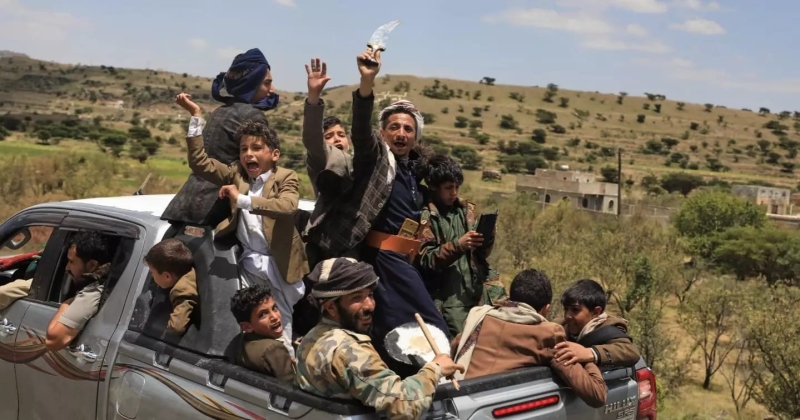
Yemeni civilians celebrate while riding in the back of a pickup truck in the Bani Matar district, Yemen, Saturday, Sept. 12, 2026, as they follow a convoy carrying Houthi prisoners freed in Mokha on its way to Sanaa following the Houthi takeover of the southern Red Sea port city.
A key Saudi oil pipeline hit in a drone attack is expected to remain largely out of service for several weeks while repairs are carried out, two regional officials said Monday.
The disruption comes as Yemen’s Houthi rebels seized more islands along major Red Sea shipping routes, putting further pressure on Saudi Arabia’s ability to export oil.
Oil prices rose more than 2% amid concerns over global supplies and the impact of the developments on the world’s biggest oil exporter. Saudi Arabia has already shifted much of its oil exports away from the Persian Gulf because Iranian attacks have disrupted shipping through the Strait of Hormuz, the gulf’s only outlet.
The kingdom has relied heavily on its 1,200-kilometre East-West Pipeline to transport crude from Gulf ports to Yanbu on the Red Sea, where the oil can be loaded onto tankers for export. Saudi authorities shut the pipeline after Thursday’s attack, which Riyadh blamed on drones launched by Iranian-backed militias in Iraq.
Repair work, including damage at a major pumping facility, could take three to five weeks, the officials told The Associated Press. The pipeline could operate at reduced capacity during the repairs, although it was unclear how much oil would be transported.
The officials spoke on condition of anonymity because they were not authorized to brief the media.
The pipeline has transported an average of 2.6 million to 4 million barrels of oil per day since late August, according to an analysis released Monday by Norway-based Rystad Energy. If the pipeline is completely shut, that volume could be removed from the global market.
Brent crude prices reached $109 a barrel, which Rystad said showed that markets were increasingly factoring in a major supply loss.
Saudi oil giant Aramco, which operates the pipeline, did not immediately respond to an AP request for comment. The government-run Center for International Communication said it was looking into AP’s questions about the repair timeline.
Houthi island seizures raise shipping concerns
Meanwhile, Yemen’s Iranian-backed Houthi rebels expanded their presence near key Saudi shipping routes by capturing the strategic Greater and Lesser Hanish islands, government and Houthi officials said Monday.
The islands are about 160 kilometres north of the Bab el-Mandeb Strait, a vital maritime passage linking the Red Sea with the open ocean and routes to Saudi Arabia’s major Asian markets.
The Houthi advance also places the rebels about 32 kilometres from a US military base in Djibouti, on the opposite side of the strait.
For more than a month, the Houthis have attacked Saudi oil facilities and shipping in the Red Sea, increasing pressure on global oil prices and strengthening Iran’s position in its war with the United States.
The rebels appeared to face little resistance from Saudi-backed Yemeni government forces. Two government officials and a Houthi official said hundreds of government-allied troops had withdrawn from the Hanish islands before the rebels moved in.
Last week, the Houthis captured the port city of Mokha and Mayun island, which lies inside the Bab el-Mandeb Strait.
Yemeni government forces are now trying to regroup. The military said Sunday that it carried out airstrikes on Houthi positions in Mokha, the coastal town of Dhubab and other areas of Taiz province.
A Houthi spokesperson said the rebels fired dozens of missiles and drones at the King Khalid Air Base in Khamis Mushait in southern Saudi Arabia, targeting hangars, radar facilities and ammunition depots. Brig. Gen. Yahya Saree did not say when the attacks occurred.
Saudi military spokesperson Maj. Gen. Turki al-Malki said the attacks hit civilian areas in Khamis Mushait and nearby cities, injuring 13 civilians and damaging several homes and vehicles. He did not say whether the air base was struck.
Saudi export options narrowing
Saudi oil production has already fallen sharply during the Iran war. The International Energy Agency said output dropped to about 6 million barrels per day in August from nearly 10 million barrels per day in September last year.
Rystad Energy said the East-West Pipeline had carried most of Saudi Arabia’s oil exports since the war began.
When Houthi attacks on ships in the Bab el-Mandeb Strait began in late July, most tankers leaving Yanbu turned north through the Red Sea toward the Mediterranean. Their cargoes were then transported through the Suez Canal or an Egyptian pipeline.
The longer route has significantly increased the time and cost of delivering Saudi oil to major customers in Asia. The Houthis have also expanded attacks on Saudi-linked shipping in the northern Red Sea.
Rystad said a monthlong pipeline shutdown would cause a major disruption, making crude deliveries slower and more expensive. While the market could initially absorb the disruption, a longer closure would require a major reshuffling of global oil flows.
Thousands flee renewed fighting in Yemen
Fighting in Yemen is pushing the impoverished country toward another full-scale civil war after a truce that had largely kept the conflict quiet since 2022.
As the Houthis advance along the Red Sea coast, they have also launched an offensive inland, particularly in Taiz province, a longtime center of fighting.
The World Health Organization said more than 500 people were killed in Yemen over the past week, compared with nearly 200 the previous week.
The Houthis have made rapid gains, capturing areas previously controlled by forces loyal to the internationally recognized government. The fighting has displaced nearly 94,000 people.
“Many of them don’t have enough food or water as they had to flee with whatever they could carry. In some areas, whole villages have reportedly emptied,” said Khanzad Shah, acting head of Islamic Relief, a charity operating in the area.
About 200 schools have been turned into shelters in southwestern Yemen to accommodate displaced families, said Basma Alloush, deputy director of communications at the International Rescue Committee.
The renewed fighting threatens to restart a war that has devastated Yemen for more than a decade, killing over 150,000 people and pushing the country close to famine.
The Houthis have controlled northern Yemen, including the capital Sanaa, and much of the country’s densely populated western heartland since 2014. The internationally recognized government, backed by various militias, controls southern and eastern areas, including the key port city of Aden.