

- PM releases fish fry into Brahmaputra in Kishoreganj |
- Miraz puts Bangladesh within sight of victory as Australia stutter |
- Scale 7.7 quake off Indonesia coast, kills at least 47, topples homes |
- PM for swift steps to restore energy supply, patience to resolve crisis |
- 7 crore people to get mobile internet access within 6-12 months |
CPD recommends renewables, finance, reforms to decarbonise RMG
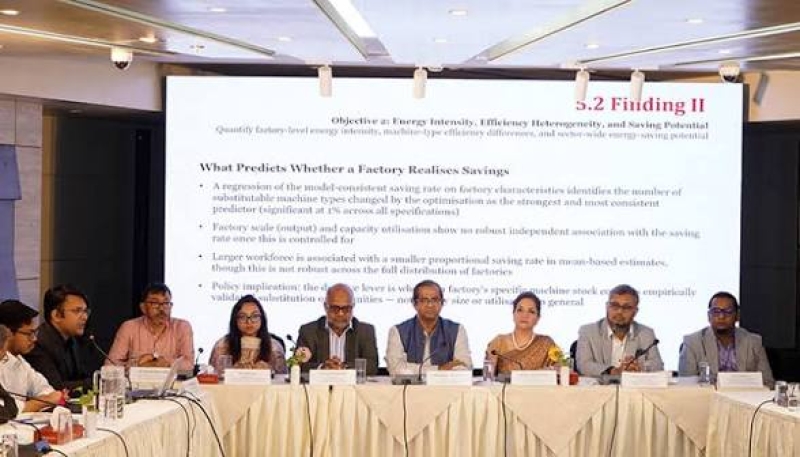
The Centre for Policy Dialogue (CPD) has recommended a comprehensive and coordinated strategy involving efficient machinery, renewable electrification, targeted financing and outcome-based regulation to accelerate industrial decarbonisation in Bangladesh's ready-made garment (RMG) sector.
The recommendations were made in a CPD study titled "Renewable Energy as a Competitiveness Strategy for Industrial Decarbonization in Bangladesh's RMG Sector" presented at a national dialogue on "Industrial Decarbonisation in the RMG Sector: How to Take it Forward?" in the city today.
Dr Khondaker Golam Moazzem, Research Director of CPD, moderated the event while Sami Mohammad, Programme Associate of CPD, and Atikuzzaman Shazeed, Research Associate of CPD, presented the findings of the study.
The study covered 350 RMG factories and examined energy use, machinery efficiency, renewable energy adoption and financial and institutional barriers.
According to the study, the RMG sector remains structurally locked into carbon-intensive production, meaning incremental energy-efficiency measures alone will not be sufficient to achieve deep decarbonisation.
The study found that capital and energy function as complements under the existing production system, while a core group of machines remains difficult or impossible to substitute.
The CPD therefore recommended directing machinery replacement incentives toward areas where significant energy savings are technically feasible.
Cutting, for example, accounts for around 5.5 percent of the installed machine stock but could deliver about 27 percent of total savings, while sewing represents around 85 percent of the machine stock but provides less than 3 percent of substitution-based savings.
The think tank also called for a shift towards overall renewable electrification, alongside long-term research and development into lower-energy sewing technologies.
It stressed that policy support should not focus solely on machine substitution, particularly because sewing has a large irreplaceable machine core.
The CPD recommended giving greater policy attention to thermal processes in washing and dyeing, which the study identified as the most energy-intensive production stage.
Rooftop solar can offset grid and captive electricity consumption, but it cannot currently replace gas-fired boilers used in thermal processes.
On financing, the CPD urged the government and financial institutions to expand blended finance, combining private investment, concessional lending and government-backed credit, particularly for smaller factories.
The study found that smaller factories face the largest efficiency gaps, with the smallest group showing a 57.3 percent energy-saving gap compared with 8.9 percent for the largest factories.
The study also recommended that financial institutions develop standardised appraisal frameworks for renewable energy and energy-efficiency investments to reduce the technical burden on factories seeking loans.
The CPD further called for outcome-based regulation, including mandatory energy audits and standardised emissions reporting, rather than an approach focused mainly on procedural compliance.
It also recommended better coordination among institutions to reduce transaction costs related to renewable energy projects.
The study suggested formalising buyer-driven incentives by encouraging preferential sourcing from factories that demonstrate verified progress in decarbonisation.
It also proposed wider dissemination of model-factory experiences to overcome information and behavioural barriers.
The CPD found that renewable energy can also improve factories' cost predictability.
Under an illustrative 30 percent solar-offset scenario, average monthly energy costs could fall by 15.7 percent, while a 10 percent offset-the maximum observed in the sample-could reduce costs by 5.5 percent.
A simulation of energy-price uncertainty showed that renewable adoption could reduce monthly energy-cost volatility, with the coefficient of variation falling from 0.1148 to 0.1102 under the renewable-offset scenario. The study said the reduction was positive for 96 percent of factories.
However, implementing the study's recommended machine reallocation would require substantial investment.
The estimated sector-wide cost ranges from Tk 6,604 crore for 50 percent adoption to Tk 13,209 crore for full adoption, with the largest factories accounting for the bulk of the cost.
The CPD concluded that decarbonisation of the RMG sector should be treated not simply as an environmental obligation but as a competitiveness strategy, particularly as global buyers increasingly place importance on verified emissions performance.
It stressed that technological, financial, institutional and behavioural interventions must be implemented in a coordinated manner to break the sector's carbon lock-in.
The recommendations at a glance are: targeted incentives for efficient machinery; accelerated renewable electrification; long-term R&D for low-energy sewing technology; measures to decarbonise thermal processes; blended finance for smaller factories; outcome-based regulation and mandatory energy audits; standardised emissions reporting; coordinated institutional approvals; buyer-driven incentives; and standardised financial appraisal systems for green investment, reports BSS.