

- PM Proposes Five Urgent Steps to Resolve Rohingya Crisis |
- Govt Appoints Indonesian Firm to Operate Cox’s Bazar SPM |
- ADB lowers Bangladesh’s growth forecast to 4 % in FY2027 |
- El Niño Tests Global Readiness for a Changing Climate |
- Dhaka's air quality recorded moderate on Wednesday morning |
Bangladesh eyes regional leadership in halal products: BIDA
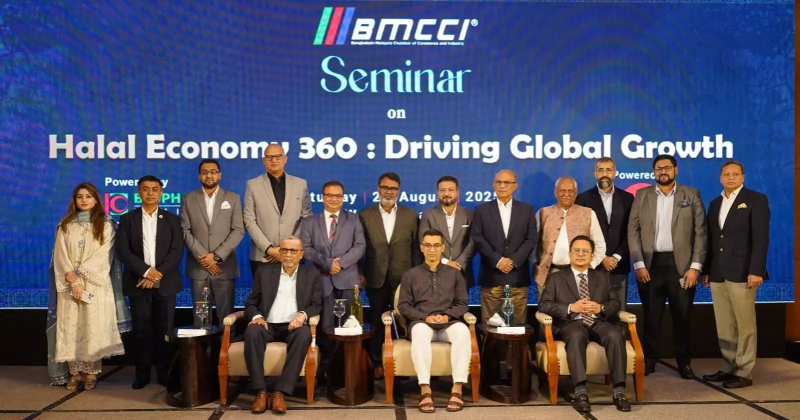
Bangladesh is aiming to position itself as a regional hub for halal products, said Chowdhury Ashik Mahmud Bin Harun, Executive Chairman of the Bangladesh Investment Development Authority (BIDA) and Bangladesh Economic Zones Authority (BEZA).
Speaking at a seminar titled ‘Halal Economy 360: Driving Global Growth’ on Saturday, he highlighted the interim government's commitment to building a conducive environment for the halal economy and fostering strategic initiatives to tap into the trillion-dollar global market.
Organised by the Bangladesh-Malaysia Chamber of Commerce and Industry (BMCCI), the event focused on unlocking Bangladesh’s potential in the halal sector and explored opportunities for collaboration with Malaysia to promote sustainable and inclusive growth.
Malaysian High Commissioner to Bangladesh, Mohd Shuhada Othman, reaffirmed strong bilateral ties and expressed Malaysia’s willingness to share its expertise in developing the halal economy. “This collaboration can yield significant benefits for both nations,” he said.
Trade between Bangladesh and Malaysia currently shows a significant imbalance. In FY2023–24, Bangladesh imported goods worth $2.6 billion from Malaysia, while its exports to the country stood at only $293.51 million, according to BMCCI.
BMCCI Secretary General Md Motaher Hoshan Khan also addressed the event, which brought together policymakers, industry leaders, and experts to examine the halal economy’s evolving landscape.
In his remarks, Chowdhury pointed out the irony that most halal products are currently produced by non-Muslim countries. However, he stressed that this presents a key opportunity for Muslim-majority countries like Bangladesh to take the lead in this growing sector.
He detailed several government initiatives aimed at enhancing infrastructure, attracting investment, and streamlining the halal certification process to boost local production.
Chowdhury called for stronger collaboration between the public and private sectors to unlock the full potential of the halal economy, noting that innovation and sustainability would be key drivers of future growth.
BMCCI President Shabbir A Khan described the halal economy as a vital engine for global trade and investment, urging stakeholders to coordinate efforts in making Bangladesh a strong contender in the halal product supply chain.
He projected that, beyond traditional garment exports, Bangladesh could realistically achieve $7–8 billion in halal exports to Malaysia alone by 2030 with the right policy framework, investment environment, and certification streamlining.
Citing market research, Shabbir noted that the global halal food market is expected to reach $3.3 trillion in 2025 and grow to $9.45 trillion by 2034, representing a compound annual growth rate of 12.42%.
The seminar featured a working session chaired by Syed Alamgir, adviser at Uttara University’s School of Business. Dr Mominul Islam, Assistant Professor at IUBAT, presented the keynote paper, offering a detailed roadmap for growth in the halal sector.
Panel discussions included insights from experts across industries, followed by an open forum where participants exchanged views on policy, innovation, and market strategies.
Speakers and participants expressed strong interest in partnering with the government to accelerate the development of Bangladesh’s halal industry and make it globally competitive.