

- Dhaka Ranks 6th Among World's Most Polluted Cities on Wednesday |
- RMG Workers' Minimum Wage Raised 36% to Tk 17,000 |
- Decades of gains against AIDS could unravel as HIV funding dries up |
- Five women killed every hour by partners or family members |
- Five Auto-Rickshaw Passengers Killed in Cox’s Bazar Crash |
Australian Minister Faces Questions Over Jamaat Chief’s Visa
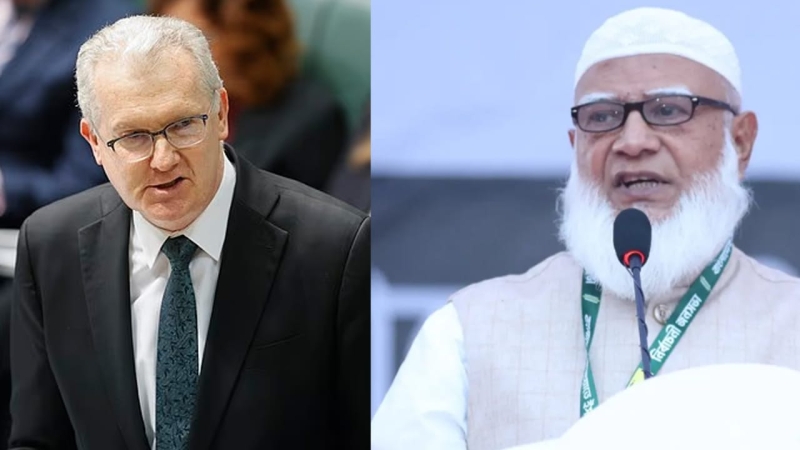
Australia’s Minister for Home Affairs, Tony Burke, and the Ameer of Bangladesh Jamaat-e-Islami, Dr. Shafiqur Rahman
Australian Home Affairs Minister Tony Burke is facing questions over the visa granted to Bangladesh Jamaat-e-Islami chief and opposition leader Dr Shafiqur Rahman, following concerns raised by Jewish and Hindu organisations about his visit to the country.
The organisations have questioned the decision to allow Shafiqur to travel to Australia, citing his alleged praise for former Hamas leader Yahya Sinwar and his reported description of former Jamaat leaders convicted of crimes against humanity during the 1971 Liberation War as martyrs. They have called on Burke to explain the visa approval.
The concerns were raised in a joint statement by the Australian Jewish Association (AJA) and the Australian Hindu Association (AHA), which expressed “serious concern” over Shafiqur’s visit.
Shafiqur travelled to Australia for a five-day visit and reportedly said he would meet Australian government officials during his stay. The two organisations have questioned whether any government representatives met him and why he was permitted to enter the country.
According to reports, Shafiqur had praised the late Hamas leader Yahya Sinwar after his death, describing him as a hero who sacrificed his life fighting for Palestinian independence.
Sinwar was widely identified as one of the key planners of Hamas’s October 7, 2023, attack on Israel, in which around 1,200 people were killed, according to the reports.
The reports also cited Shafiqur’s alleged description of former Jamaat-e-Islami leaders convicted of war crimes and crimes against humanity over atrocities committed during Bangladesh’s 1971 Liberation War as “martyrs”.
The joint statement by the AJA and AHA also referred to Shafiqur’s reported remarks about another former Hamas leader, Ismail Haniyeh. The organisations said he had mourned Haniyeh’s death and prayed for him to be recognised as a martyr.
The groups further raised concerns over Jamaat-e-Islami’s historical record, noting that several of the party’s former senior leaders were convicted of war crimes and crimes against humanity.
They also expressed concern over reports that the Australian National Imams Council (ANIC) hosted Shafiqur at a luncheon in Sydney on November 21, with several Australian lawmakers reportedly attending.
The organisations have asked the Australian government to clarify why Shafiqur was allowed into the country and whether any government representatives held meetings with him.
AJA President Robert Gregory criticised the decision, referring to Australia's previous restrictions on visits by former Israeli Justice Minister Ayelet Shaked and Israeli lawmaker Simcha Rothman.
He questioned why those Israeli figures had faced visa restrictions over concerns about social cohesion while a political leader accused of praising Hamas figures had been allowed to visit Australia.
AHA President Amendra Singh also expressed concern, alleging that extremist groups had been involved in killings, attacks, arson, abductions, looting and intimidation targeting Hindus in Bangladesh.
He warned that welcoming individuals who support or remain silent about such acts could deepen divisions within Australian society and undermine social cohesion.
Meanwhile, Sydney-based migration adviser Raymond Salomonn has formally urged Burke to cancel Shafiqur’s visa.
Salomonn argued that the Jamaat chief did not meet Australia's character requirements and that his presence could pose a risk to social cohesion.
Speaking to Australian media, Salomonn said Burke had previously pledged to scrutinise visa applicants’ backgrounds more carefully but had failed to ensure that the commitment was reflected in this case.
He also raised a possible conflict-of-interest concern, noting that Burke’s parliamentary electorate includes the suburbs of Lakemba and Bankstown.
Salomonn said the minister was responsible for protecting Australians and securing the country's borders and should therefore be held accountable for the decision.
The Australian Department of Home Affairs was contacted for comment on the matter. However, the report did not say whether the department had responded.