

- HSC Results 2026 Published, Pass Rate Stands at 52.12% |
- Nations Agree to Revive Efforts to Meet 2030 Nature Goals |
- Dhaka Among World’s 15 Most Polluted Cities on Saturday |
- Over 12.70 lakh candidates await HSC, equivalent exam results |
- AI changing the way we think. Will we notice in time |
South Korean President May Visit Bangladesh This Year
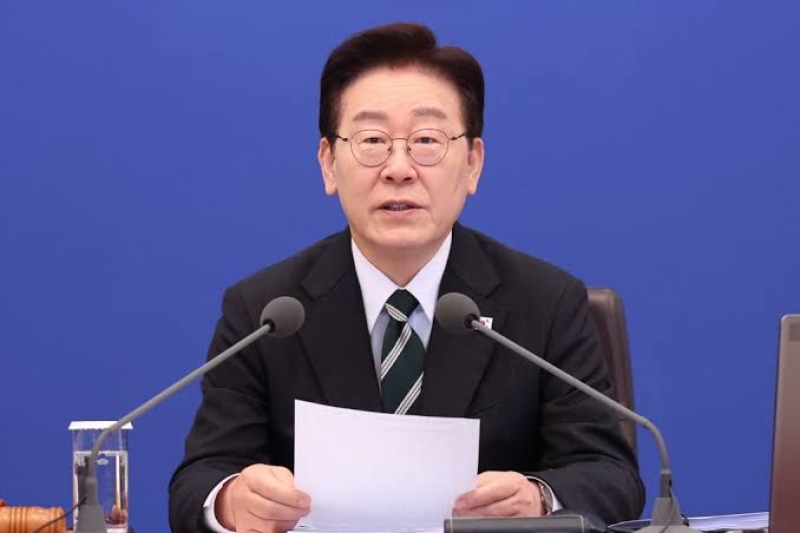
South Korean President Lee Jae Myung
South Korean President Lee Jae Myung may visit Bangladesh at a mutually convenient time this year as the two countries move closer to signing a Comprehensive Economic Partnership Agreement (CEPA) to boost trade, investment and economic cooperation, diplomatic sources in Dhaka and Seoul have said.
State Minister for Foreign Affairs Humaiun Kobir handed over an invitation from Prime Minister Tarique Rahman to President Lee during a visit to Seoul in early October, inviting the South Korean leader to visit Bangladesh.
The invitation was conveyed during a bilateral meeting with Park Yoon-joo, First Vice Minister of Foreign Affairs of the Republic of Korea. The two sides discussed issues of mutual interest, with particular emphasis on political and economic cooperation.
During the meeting, Humaiun Kobir expressed Bangladesh’s readiness to work closely with the South Korean government to strengthen the longstanding friendly relations between the two countries.
Both sides are working on arrangements and a possible itinerary for the proposed visit, diplomatic sources said.
Trade, investment, energy, labour migration, concessional loans, defence and regional cooperation, as well as the Rohingya crisis, are likely to feature prominently in discussions.
Bangladesh is expected to seek greater South Korean investment in energy, textiles, information technology and services, alongside cooperation in other key sectors.
South Korean Investment and Concessional Loans
According to Bangladesh Bank data, net foreign direct investment inflows from South Korea stood at $150.23 million in 2015, rising to $151.33 million in 2016 and $179.80 million in 2017. The figure fell to $72.97 million in 2018 and $4.22 million in 2019 before recovering to $59.43 million in 2020 and $140.50 million in 2021.
South Korean investment inflows reached $298.31 million in 2022 before declining to $165.85 million in 2023. They rose to $299.73 million in 2024 and stood at $171.70 million in 2025.
Economic Relations Division officials said Bangladesh is likely to seek $8 billion to $9 billion in South Korean concessional loans and grants to support around 20 to 25 major projects.
The proposed projects include MRT lines 4 and 5, the second phase of Cox’s Bazar airport, railway development, electric buses and hospitals.
South Korean concessional loans carry interest rates ranging from 0.01 to 0.05 per cent, repayment periods of up to 40 years, including a 15-year grace period, and a service charge of 0.1 per cent.
Bangladesh currently has a $3 billion framework arrangement with South Korea for the 2023–2027 period.
Rohingya Crisis and Defence Cooperation
The Rohingya crisis is also expected to be a major issue during the proposed visit. More than 1.5 million Rohingya refugees are placing considerable economic and social pressure on Bangladesh and raising security concerns, a senior Foreign Ministry official said.
Bangladesh will seek South Korean support for the repatriation of Rohingya refugees to Myanmar’s Rakhine State, the official added.
Dhaka is also likely to invite South Korean investment in a proposed defence industrial zone, with the aim of securing technology transfers, promoting industrial cooperation and generating wider economic benefits.
Bangladesh Seeks More Jobs for Its Workers in South Korea
Labour migration is another important area of potential cooperation. With South Korea facing an ageing society and a declining working-age population, Bangladesh wants to increase the number of its workers employed there.
However, Bangladesh has made limited progress in expanding its manpower exports to South Korea, despite competition from countries including the Philippines, Thailand, Laos, Cambodia, Nepal and Vietnam, a leader of the Bangladesh Association of International Recruiting Agencies said.
Bangladesh sent 1,323 workers to South Korea between January and October 2026, according to the Bureau of Manpower, Employment and Training.
South Korea’s growing reliance on foreign workers is reflected in recent migration trends. Vietnam overtook China in 2025 to become the largest source of long-term foreign arrivals in South Korea for the first time, according to the country’s Ministry of Data and Statistics.
Around 98,000 Vietnamese nationals entered South Korea for stays exceeding 90 days in 2025, compared with 94,000 Chinese nationals. Arrivals from Vietnam have increased for three consecutive years since 2022, while those from China have declined.
South Korea’s total population reached 51.82 million in 2025, up 0.02 per cent from the previous year despite a decline in the number of Korean nationals. Foreign residents accounted for a record share of the population, according to official data.
The country faces one of the world’s most severe demographic challenges. Preliminary government figures for 2025 recorded around 254,500 births and 363,400 deaths, resulting in a natural population decline of approximately 108,900.
People aged 65 and above accounted for 21.2 per cent of the population in 2025, meaning more than one in five South Koreans was elderly.
CEPA Expected to Expand Bilateral Trade
The proposed CEPA is expected to provide a broader framework for expanding trade and investment between the two countries.
Prime Minister Tarique Rahman invited the South Korean president to visit Bangladesh during a meeting with South Korean Trade Minister Han-Koo YEO on August 3.
During the meeting at the Prime Minister’s Office in the Secretariat, Han-Koo YEO briefed the prime minister on the proposed CEPA, saying it would significantly expand bilateral trade and economic cooperation while encouraging further South Korean investment in Bangladesh.
He said many South Korean companies were already operating successfully in Bangladesh and that more were interested in investing.
Tarique Rahman urged South Korean companies to explore investment opportunities in toy manufacturing, electronics, telecommunications, automobiles, semiconductors and shipbuilding.
He said South Korea’s expertise in shipbuilding, combined with Bangladesh’s workforce potential, offered significant opportunities for cooperation.
The prime minister also proposed establishing technical and language training centres in Bangladesh to prepare workers for employment in South Korea’s shipbuilding industry. He assured South Korean investors of the government’s support for investment in the sector.
The Bangladesh side also proposed organising a seminar involving South Korean companies to showcase investment opportunities in the country.
Han-Koo YEO welcomed Bangladesh’s initiatives to improve its investment climate, saying they would help strengthen bilateral relations and create new opportunities for economic cooperation.