

- Support to coastal security, early completion of MRT lines, Airport Terminal III, business promotion assured |
- Tarique Seeks Japanese Support for Energy, Tech and Infrastructure |
- Japan eyes 1 trillion yen investment in Bangladesh over 5 years |
- Dhaka Among World’s 11 Most Polluted Cities on Tuesday |
- Tide Rising, Time Running Out For Coastal People, Wildlife |
Support to coastal security, early completion of MRT lines, Airport Terminal III, business promotion assured
Japan-Bangladesh Joint Statement
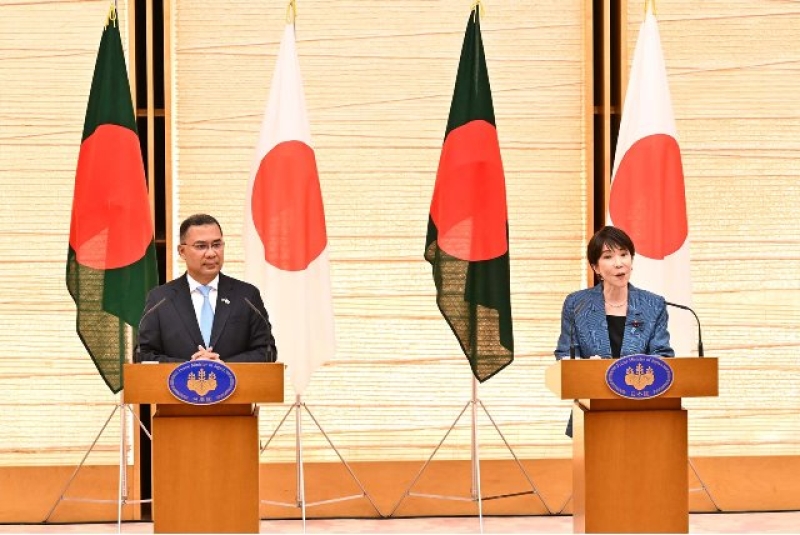
Prime Minister Tarique Rahman and Japanese Prime Minister Sanae Takaichi holding a joint press conference after their bilateral talks on Tuesday 27 October 2926. Photo - PID
1. On October 27, 2026, Prime Minister of Japan H.E. Takaichi Sanae and Prime Minister of the People’s Republic of Bangladesh H.E. Tarique Rahman, MP held a bilateral summit meeting in Tokyo during his official visit to Japan from 26th to 29th October 2026.
2. The two Prime Ministers valued the longstanding friendly relations since the independence of Bangladesh and the developments in a wide range of economic cooperation under the “Strategic Partnership” in infrastructure, energy, human resource development, trade, and investment between the two countries. They reaffirmed their shared values of democracy, freedom and rule of law. Prime Minister Rahman expressed his sincere appreciation for Japan’s consistent support, including through development assistance, over the last five decades towards Bangladesh’s developmental journey. He commended Japan’s consistent role as a peace-loving nation and appreciated its constructive role toward global peace, stability and prosperity. Prime Minister Takaichi highly appreciated vibrant democracy in Bangladesh and welcomed the successful general election in February 2026, held in a credible and peaceful manner as witnessed by an election observer mission dispatched by the Government of Japan. She congratulated Prime Minister Rahman for the assumption of his office.
3. The two Prime Ministers reaffirmed their commitment to work towards upholding international order which is free, open and based on the rule of law. To this end, Prime Minister Rahman noted the importance of Prime Minister Takaichi’s initiative of the “Free and Open Indo-Pacific (FOIP)” in ensuring peace, stability and prosperity for all.
4. BIG-B for Shared Prosperity
Recalling the progress made under the bilateral flagship initiative of the BIG-B, which is an exclusive partnership between Japan and Bangladesh, and considering the rapidly changing global situation, a more prevalent supply chain risk, rapid technological innovation and mounting social issues, the two Prime Ministers noted the importance of enhancing resilience and preserving each country’s freedom of decision. To this end, they decided to upgrade the initiative into “BIG-B for Shared Prosperity.”
They shared the view that the “BIG-B for Shared Prosperity” aims to integrate the development of power, energy, deep-sea port, industrial and ICT infrastructure, build a major nexus for industrial value chains, develop into a trade and supply gateway and generate growth and prosperity, by a) enhancing connectivity, b) enhancing resilience against risks including natural disasters and geopolitical uncertainties, c) public-private partnership in co-creating opportunities for economic growth and rulemaking, and d) stepping up cooperation for peace and stability.
Based on the “BIG-B for Shared Prosperity,” they concurred on working together to develop the Matarbari-Maheshkhali area as a major hub for logistics, energy and industry, centered at the Matarbari Deep Sea Port.
a) Enhancing connectivity
To sustain rapid economic growth, the two Prime Ministers reaffirmed their commitment to steadily advance cooperation aimed at further strengthening connectivity in the region. In particular, they concurred to proceed with preparatory work for the early operationalisation of the 3rd Terminal at Dhaka’s Hazrat Shahjalal International Airport. They also aspired to move forward with the early construction of Dhaka MRT lines as well as to discuss on future cooperation including the operation and management of Matarbari Deep-Sea Port.
b) Enhancing resilience against risks including natural disaster and geopolitical uncertainties
Recognising the increasing volatility of global energy markets and the energy price surge, the two Prime Ministers reiterated the importance of international cooperation on strengthening oil stockpiles and close coordination on energy between producing and consuming countries, including through Japan’s Partnership On Wide Energy and Resources Resilience Asia (POWERR Asia). Prime Minister Rahman appreciated the 50 billion yen “Emergency Support Loan for Enhancing Economic Resilience and Stable Energy Supply,” the first yen loan project under POWERR Asia. Prime Minister Takaichi expressed Japan’s continuous support on energy infrastructure to bridge the gap between energy supply and demand in Bangladesh.
The two Prime Ministers acknowledged the need for intensified global efforts to combat climate change and underlined the deepening of cooperation between the two countries in the development of a long-term low-emission development strategy, increasing energy efficiency and energy capacity, and promoting renewable energy. In this regard, they welcomed the signing of the Letter of Intent (LoI) on climate change cooperation between the Ministry of the Environment of Japan and the Ministry of Environment, Forests, and Climate Change of Bangladesh, as well as public-private dialogues which have been prompted under the Memorandum of Cooperation (MOC) on environmental cooperation.
Amid heightened global economic uncertainty, the two Prime Ministers reaffirmed the importance of economic security and resilience, and the rules-based international economic order. They concurred to further cooperate on economic security in areas such as energy security, supply chain resilience, and secure and resilient digital connectivity.
c) Public-private partnership in co-creating opportunities for economic growth and rulemaking
Prime Minister Takaichi commended the efforts made by Prime Minister Rahman’s administration to promote foreign direct investment and welcomed a projection of upcoming private investment from Japan to Bangladesh up to one trillion yen with two hundred thousand jobs to be created in Bangladesh by the investment from Japan in the next five years. The two Prime Ministers welcomed major investments to be announced at this occasion and also shared the view to establish complementary and resilient supply chains in areas such as manufacturing, food and agriculture sectors, ICT, and pharmaceuticals. Building upon past bilateral cooperation in the ICT sector, including IT & Information Technology Enabled Services (ITES), human resource development and digital collaboration, they shared the view on the importance of exploring further possibilities for cooperation to promote digital transformation (DX), the development of highly skilled ICT professionals, and secure and reliable digital connectivity.
With a view to enhancing economic exchange between the two countries, Prime Minister Takaichi emphasized the need to further improve the investment environment in Bangladesh, and Prime Minister Rahman highlighted various recent government initiatives and committed to facilitating it including by enhancing rulemaking, transparency and predictability of the operational procedures related to taxation, customs clearance, remittances, and licensing. The two Prime Ministers welcomed the signing of the Memorandum of Cooperation (MoC) between the Ministry of Economy, Trade and Industry of Japan and the Economic Relations Division, Ministry of Finance of Bangladesh on economic relations and the improvement of the business environment. The two Prime Ministers also welcomed the signing of two MoCs between the Ministry of Agriculture, Forestry and Fisheries of Japan and, respectively, the Ministry of Agriculture of Bangladesh and the Ministry of Fisheries and Livestock of Bangladesh, to strengthen and expand mutual cooperation to enhance business and attract investment in the areas of food, agriculture, fisheries, and livestock. They also welcomed the pledging of a yen loan project to improve the investment environment.
To maintain and enhance the momentum of business promotion following a significant commitment made by Japanese businesses, they expressed their willingness to plan a business delegation from Japan to Bangladesh and hold economic dialogues in near future, as well as promoting bilateral cooperation within the Japan-Bangladesh Joint PPP Platform and the Bangladesh Special Economic Zone (BSEZ).
The two Prime Ministers reiterated the importance of upholding a free, fair and rulesbased international economic order. In this context, they welcomed the signing of the Japan-Bangladesh Economic Partnership Agreement (EPA) and reaffirmed their commitment to the early entry into force of the Agreement with the aim of bringing its mutual benefits to the peoples of both countries. They once again expressed their commitment to promoting trade and investment between the two countries, as well as industrial diversification through the EPA, thereby supporting Bangladesh’s smooth, sustainable, and resilient transition from Least Developed Country (LDC) status. Prime Minister Takaichi stated that Japan looks forward to the furtherance of discussions on Bangladesh’s request for accession to the Regional Comprehensive Economic Partnership (RCEP) Agreement.
d) Stepping up cooperation for peace and stability
Amidst an increasingly uncertain geopolitical environment, the two Prime Ministers reaffirmed to further enhance bilateral security cooperation. In this context, they welcomed the signing and entry into force of the Agreement concerning the Transfer of Defense Equipment and Technology. They discussed the review of Japan’s Three Principles on the Transfer of Defense Equipment and expressed their expectation for further progress in bilateral cooperation. Prime Minister Takaichi acknowledged that Bangladesh has been one of the largest contributors to the UN peacekeeping operation. She also expressed Japan’s commitment to deepen cooperation that contributes to maintaining peace and stability through defense cooperation between the two countries, capacity building in maritime situation awareness, coastal patrol and port security. The two Prime Ministers welcomed the provision of a patrol vessel through Japan’s Official Development Assistance (ODA) to strengthen the coastal security capabilities of Bangladesh. They also welcomed the provision of five patrol boats through Japan’s Official Security Assistance (OSA) program and committed to exploring future cooperation under the OSA program.
5. The two Prime Ministers reiterated the importance of resilient and inclusive development to further promote Bangladesh’s efforts to address the economic and societal challenges for the people of Bangladesh. Prime Minister Rahman highlighted his government’s commitment to Bangladesh’s people for good governance, providing social and financial assistance and balanced regional development. They concurred to continue cooperating to strengthen human capital, build up skilled workforce, overcome social vulnerabilities, and build sustainable cities and local governments through collaboration in areas such as public health and medical care, education, disaster risk reduction and management, and waste management. They welcomed the pledge on the “Upazila Governance and Development Project (Phase 2),” a yen loan program aimed at strengthening the administrative and fiscal capacities of local governments. They reaffirmed the importance of quality infrastructure, transparent and equitable development finance and debt sustainability and transparency. They also reaffirmed their commitment to cooperation in capacity building of judicial officials through Japan’s legal technical assistance.
6. The two Prime Ministers expressed their commitment in promoting people-to-people exchanges. In this regard, they welcomed the holding of the “Japan Festival” in Dhaka in September this year to promote Japanese culture and foster diverse cultural exchanges. In this context, they emphasised the importance of cultural exchanges between the two countries. They recognised the important role played by the Department of Japanese Language and Culture at the University of Dhaka in Japan-related research and the promotion of academic exchanges between the two countries. They concurred to promote collaboration in educational field through existing programs such as Japan-related research and Japanese government (MEXT) scholarship. They further concurred to explore opportunities for enhanced exchanges and capacity development for senior public officials of Bangladesh, and to promote Japanese language education in Bangladesh, including through cooperation with relevant Japanese institutions, with a view to fostering long-term people-to-people ties and mutual understanding.
Regional and International Situation
7. The two Prime Ministers observed that actions that hamper the safety as well as freedom of navigation and overflight are not acceptable. They reaffirmed the importance of the peaceful settlement of all international maritime disputes through dialogue, negotiations and judicial proceedings in accordance with international law, as reflected in the 1982 United Nations Convention on the Law of the Sea (UNCLOS).
8. The two Prime Ministers shared their concerns over continued development of nuclear weapons and ballistic missile programs in violation of UN Security Council resolutions (UNSCRs) in the Korean Peninsula. They called for immediate resolution of the abductions issue.
9. The two Prime Ministers remain concerned by the worsening crisis in Myanmar and its impact on regional security, displacement of all people, including the Rohingyas, and the increase in transnational crimes. They called for the immediate cessation of violence; the release of those who are detained; creation of a conducive environment for the delivery of humanitarian assistance; and dialogue between all parties and affected groups, including the Rohingyas. Prime Minister Takaichi commended Bangladesh for temporarily sheltering the Rohingyas from Rakhine State and extended support for continued humanitarian assistance to them. They shared the importance of continuous and proactive engagement with all the parties to bring peace and stability through reconciliation and immediate cessation of violence against vulnerable people, including Rohingyas. In this context, Prime Minister Rahman underlined that the Rohingya problem originated in Myanmar and its solution lies in Myanmar. The two Prime Ministers shared the view that an ultimate solution to the Rohingya crisis is to realize a voluntary, safe, dignified and sustainable return of the displaced persons, including the Rohingyas to Myanmar.
10. The two Prime Ministers reiterated their commitment to promoting sustainable peace, security and stability in the Middle East. They reiterated their call for an early de-escalation of the situation, as well as the urgent and full re-opening of the Strait of Hormuz and the safe, secure and unimpeded transit of all vessels, in accordance with international law as reflected in UNCLOS, and without any additional costs. They also recognized the strategic importance of maintaining peace and stability in the Red Sea and the Bab el-Mandeb Strait for global energy security and the uninterrupted flow of goods. Moreover, they emphasized
the need to ensure the safety and security of seafarers, protect civilian vessels from attacks, and refrain from actions that endanger the lives of maritime personnel. They underscored the urgency of advancing the Comprehensive Plan to rebuild Gaza and reaffirmed their
support for a just, lasting and comprehensive resolution of the Palestine question, including
the realization of a two-state solution.
11. The two Prime Ministers reiterated their commitment to multilateralism grounded in the rule of law, respect for international law and the principles of the UN Charter, while underscoring the importance of international cooperation, collective action and a rulesbased
international order in addressing shared global challenges. Prime Minister Takaichi
commended the election of Foreign Minister Dr. Khalilur Rahman as the President of the 81st Session of United Nations General Assembly and expressed Japan’s intention to cooperate with the PGA to help build a more resilient and effective United Nations under his presidency.
12. The two Prime Ministers concurred on continued cooperation towards an early reform of the UNSC, including expansion of both permanent and non-permanent categories of membership, through positive engagement in the Intergovernmental Negotiations.
13. The two Prime Ministers affirmed their commitment to realizing a world without nuclear weapons. They reaffirmed the importance of maintaining and strengthening the Treaty on the Non-Proliferation of Nuclear Weapons (NPT) as the cornerstone of global nuclear disarmament and non-proliferation architecture, and are jointly determined to
continue to work together in this area. Prime Minister Rahman acknowledged Japan’s consistent efforts on nuclear disarmament and non-proliferation.
14. Prime Minister Rahman expressed his sincere appreciation to Prime Minister Takaichi and the people of Japan for the warm welcome and gracious hospitality extended to him and his delegation during the visit. Prime Minister Rahman cordially invited Prime Minister Takaichi to visit Bangladesh at a mutually convenient time.
Tokyo, Japan, 27 October 2026