

- Covered van hits Gazipur police patrol team, killing SI, BNP leader |
- Korean City scrambles to rescue dusky shark after it returns to canal |
- PM inspects Mongla Port, Sundarbans, proposed economic zone |
- Early winter cucumber brings hope of bumper harvest in Sirajganj |
- Saudi coalition intercepts Houthi missile after blasts in Riyadh |
European, Mideast foreign ministers to discuss Mideast crises
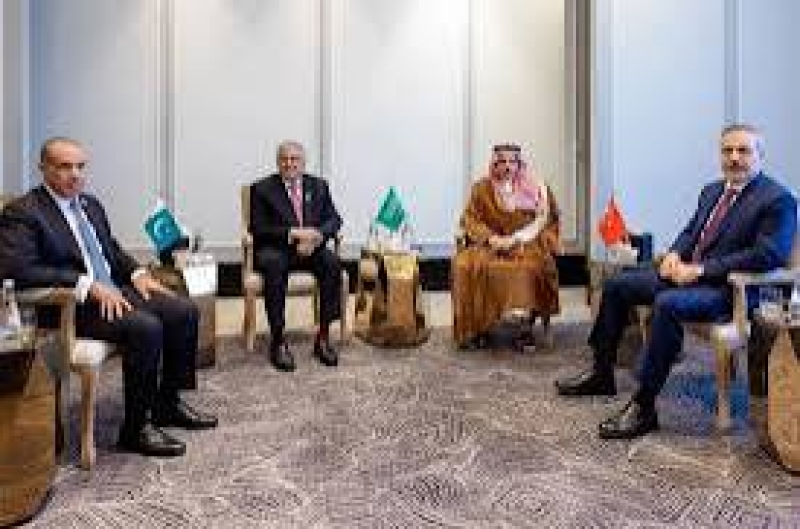
Foreign ministers from seven European and Middle Eastern countries will hold talks in Istanbul Friday focusing on the Strait of Hormuz and the crises in the Middle East.
Ministers from the so-called E3 group -- Britain, France and Germany -- will meet counterparts from the newly created R4 group comprising Turkey, Saudi Arabia, Pakistan and Egypt to discuss the Palestinians, developments in Yemen and the Strait of Hormuz, and ways to end the Russia-Ukraine war, a Turkish foreign ministry source said.
British foreign minister Ed Miliband's office said the talks would essentially revolve around "the Strait of Hormuz and the situation in Saudi Arabia".
"Despite positive progress from the US and regional partners, passage through the Strait remains under threat, with traffic through the waterway sharply down on pre-war levels," a foreign ministry statement said.
It said Miliband "will advocate for a diplomatic solution to the crisis that restores full navigational rights and freedoms" and stress "how Iranian tactics are being replicated across the region, with attacks on Saudi Arabia further destabilising the region and increasing pressure on vital waterways and global chokepoints, such as Bab El-Mandeb and the Suez Canal."
"The UK is stepping up to help stabilize the region, having this week committed RAF Typhoons to defend Saudi Arabia from Houthi attacks in their airspace," it added.
Turkish Foreign Minister Hakan Fidan is hosting the meeting, the first to bring together the two groups.
In chairing the talks, Fidan was to stress that "regional security first and foremost requires countries of the region to assume responsibility" and within that context, Turkey "prioritises strengthening cooperation mechanisms based on regional ownership".
He would also say "existing disputes should not be allowed to feed one another, conflicts should not be allowed to spread to new areas, and regional tensions should not be allowed to turn into broader instability".
Fidan will focus on the international community "increasing pressure on Israel" in response to its settlement expansion and its "encouragement of settler terrorism".
He will also underline Turkey's support for Saudi Arabia's security in the face of Houthi attacks and the need for permanent freedom of navigation in the Hormuz and Bab el-Mandeb Straits.
- Black Sea security -
Unrest in the Black Sea would also be a key focus, with the minister pointing to Turkey's ongoing "warnings and proposals" to prevent the Russia-Ukraine war from spreading to the Black Sea and to draw a line under the civilian deaths there.
Armed attacks on commercial ships, often with drones, have multiplied in recent months as the war has spilled into the Black Sea, with Turkish ships increasingly in the firing line.
Last month, Turkey sent a proposal to Russia and Ukraine to end the strikes, but it appears to have fallen on deaf ears with the attacks increasing in recent weeks, notably near Romania and Bulgaria.
NATO said Tuesday it was deploying additional planes, drones and radar systems to the Black Sea, calling for more "situational awareness" in the region through increased sensors and more data-sharing.
The E3 was set up more than 20 years ago to advance diplomatic coordination over Iran's nuclear programme.
The R4 was formed this year and brings together Egypt with the signatories to the Mecca Defence Agreement -- a mutual defence pact set up by Turkey, Saudi Arabia and Pakistan in August, reports BSS.