

- PM Proposes Five Urgent Steps to Resolve Rohingya Crisis |
- Govt Appoints Indonesian Firm to Operate Cox’s Bazar SPM |
- ADB lowers Bangladesh’s growth forecast to 4 % in FY2027 |
- El Niño Tests Global Readiness for a Changing Climate |
- Dhaka's air quality recorded moderate on Wednesday morning |
Turkiye Says Mecca Defence Pact Not Aimed At Iran
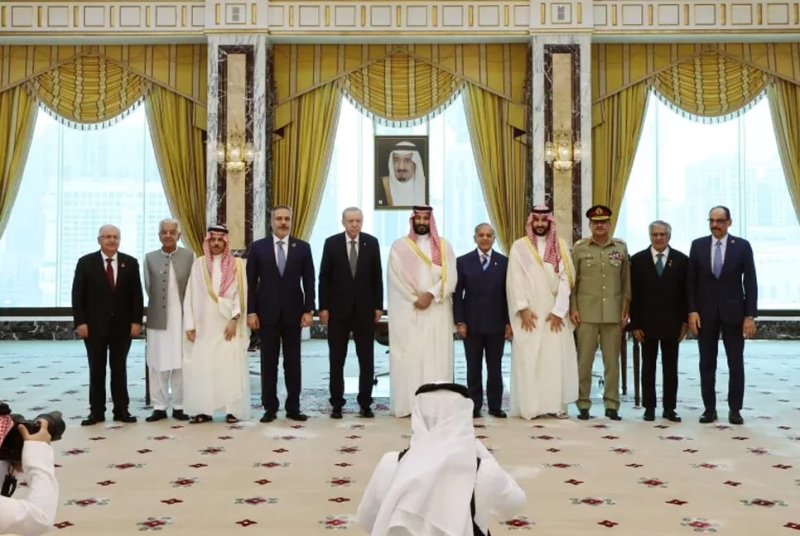
The leaders of Turkiye, Saudi Arabia and Pakistan pose with officials after signing a trilateral joint defence agreement in Mecca, Saudi Arabia, on August 7, 2026.
Turkish leaders have said the new trilateral defence pact with Saudi Arabia and Pakistan is not directed against Iran and does not identify any country as a common threat.
Turkish Foreign Minister Hakan Fidan said on Saturday that Iran was not named in the agreement and that countries that do not attack the signatories would not be considered targets.
The Mecca Joint Defence Agreement was signed on Friday by Turkish President Recep Tayyip Erdogan, Saudi Crown Prince Mohammed bin Salman and Pakistani Prime Minister Shehbaz Sharif. Under the pact, an armed attack on any of the three countries would be considered an attack on all three.
"There is no common threat that we have put in writing," Fidan said.
He described the agreement as technically similar to NATO's Article 5 collective-defence clause, under which an attack on one member is treated as an attack on all. However, he said the nature of any response would depend on the circumstances.
A country facing an attack would have to request assistance and specify the type of support required, ranging from intelligence and logistics to ammunition or military deployments, Fidan said.
The alliance will establish political and military committees involving foreign and defence ministers and military chiefs, along with a secretariat in Saudi Arabia.
The three countries also plan to cooperate on joint training, intelligence sharing, logistics, threat assessments and military interoperability.
Defence-industry cooperation is expected to be another key area, with the countries exploring ways to share military technologies and capabilities.
Fidan said preparations for the agreement had been underway for nearly two years and eight months, indicating that it was not created solely in response to current tensions involving Iran.
Despite Ankara's assurances, some Iranian officials have criticised the agreement and warned Saudi Arabia that closer security cooperation with Turkiye and Pakistan would not guarantee its security.
Iranian Foreign Minister Abbas Araghchi did not directly refer to the pact but called on regional countries to rely on themselves and pursue what he described as "true brotherhood". He also stressed the strength and readiness of Iran's armed forces.
Fidan said the agreement was part of a broader effort to give regional countries greater responsibility for their own security.
He said Turkiye, Saudi Arabia and Pakistan should serve as the core members of the initiative and indicated that Ankara wanted the arrangement to expand.
Fidan said several countries had already expressed interest, adding that Egypt could join once outstanding technical issues were resolved.