

- Fresh rain spell triggers waterlogging in Dhaka, hampers Eid prep |
- Over 1.5 million pilgrims perform Hajj amid regional tensions |
- After the blaze, Kalshi slum dwellers see what little remains |
- Dhaka, 5 other divisions to see heavy rainfall in 24 hours |
- Over 1.6 Million Pilgrims Gather at Sacred Arafat |
Equal Footing: Pathways for Landlocked Nations
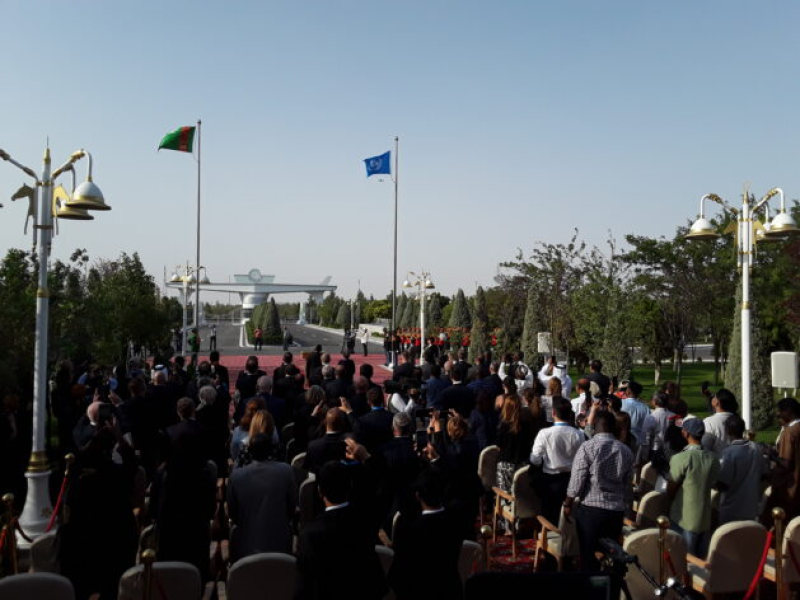
The raised flags of Turkmenistan and the United Nations marked the official opening of the Third UN Conference on Landlocked Developing Countries (LLDC3).
Heads of State, ministers, investors, and grassroots leaders have gathered in Awaza, on Turkmenistan’s Caspian coast, for a once‑in‑a‑decade UN conference aimed at rewiring the global system in support of 32 landlocked developing countries whose economies are often ‘locked out’ of opportunity due to their lack of access to the sea.
Geography has long dictated the destiny of landlocked nations. Trade costs are up to 74 per cent higher than the global average, and moving goods across borders can take twice as long compared with coastal countries. As a result, landlocked nations account for just 1.2 per cent of world trade and are at great risk of being left furthest behind amid global economic shifts.
Speaking during the opening plenary, and in the context of implementing the Sustainable Development Goals (SDGs), President of Turkmenistan Serdar Berdimuhamedow stated that his country believes “in the need to accelerate the process of ensuring transport connectivity, as well as to bring fresh ideas and momentum to this process.”
“In this connection, last year at the World Government Summit in Dubai, Turkmenistan proposed creating a new partnership format, namely a global atlas of sustainable transport connectivity. I invite all foreign participants to carefully consider this initiative.”
The Third UN Conference on Landlocked Developing Countries, or LLDC3, is pushing for freer transit, smarter trade corridors, stronger economic resilience, and new financing to boost development prospects for the estimated 600 million people living in those countries.
UN Secretary‑General António Guterres stressed that the conference reaffirms a fundamental truth: “Geography should never define destiny.”
“Yet,” Guterres continued, “for the 32 landlocked developing countries across Africa, Asia, Europe, and South America, geography too often limits development opportunities and entrenches inequality.”
For these countries, goods take an average of 42 days to enter and 37 days to exit their borders. Paved road density stands at just 12 per cent of the global average, and internet access is only 39 per cent. To address these constraints, the Awaza Programme of Action proposes a new facility for financing infrastructure investments to mobilise large amounts of capital for bridging gaps and constructing roads.
Meanwhile, debt burdens are rising to dangerous and unsustainable levels, Guterres warned, with one‑third of LLDCs facing vulnerability, insecurity, or conflict. Despite representing 7 per cent of the world’s population, LLDCs account for just over one per cent of the global economy and trade — a stark example of deep inequalities that perpetuate marginalisation.
Guterres stressed that these inequalities are not inevitable but are the result of an unfair global economic and financial architecture, unfit for the realities of today’s interconnected world, compounded by systemic neglect, structural barriers, and — in many cases — the legacy of a colonial past.
“Recent shocks — from the COVID‑19 pandemic to climate disasters, supply chain disruptions, conflicts, and geopolitical tensions — have deepened the divide, pushing many LLDCs further away from achieving the SDGs,” he said.
The conference is focused not on obstacles but on solutions, including launching a new decade of ambition through the Awaza Programme of Action and fully unlocking the development potential of landlocked developing countries.
Fatima described the Awaza Programme of Action as a bold and ambitious blueprint to transform the development landscape for the 32 LLDCs over the next decade. The theme of the conference, “Driving Progress Through Partnerships,” reflects a collective resolve to unlock that potential and marks a new era of collaboration where LLDCs are seen as integrated players, not isolated or constrained.
She said the Programme provides “the tools to unlock the full potential of LLDCs and turn their structural challenges into transformative opportunities. The implementation of the Programme of Action has begun. We arrive in Awaza with momentum on our side, with a UN system‑wide development and monitoring framework comprising over 320 completed projects, programmes, and activities.”
“Over the course of the week, we will see the launch of many new partnerships and initiatives that will bring fresh momentum to its implementation. As we take this process forward, allow me to highlight three strategic priorities that will guide our work in Awaza. First, bridging the infrastructure and connectivity gap remains our top priority,” she said.
Heads of state and governments, including the presidents of Uzbekistan, Armenia, Tajikistan, Kazakhstan, and His Majesty King Mswati III of Eswatini, stressed the significance of the conference for identifying priority areas for future efforts, with a focus on addressing modern challenges faced by the international community.
“To build resilience and ensure sustainable growth, Eswatini is diversifying beyond traditional sectors. We are promoting investment in agro‑processing, tourism, renewable energy, ICT, creative industries, and private enterprise. This strategy broadens our economic base, creates jobs, and supports inclusive development, aligning with our national priorities for 2030 and 2063,” he said.
“This year, together with our partners, we have started construction of the China‑Kyrgyzstan‑Uzbekistan railway. Freight traffic on the Uzbekistan‑Turkmenistan‑Iran‑Turkey transport corridor has increased significantly. In today’s world, it is crucial to have concrete, feasible, and institutionally supported solutions to overcome common threats and challenges,” he said.
Fatima stressed that the challenges are complex and require investment in robust implementation tools and partnerships at all levels.
“Our mapping confirms that every target adopted here in Awaza advances inclusive, resilient, and sustainable development. But policy alignment alone is not enough. We need a whole‑of‑society approach,” she said.
She urged the global community to seize this moment — with ambition, unity, and purpose — to chart a new path for the LLDCs: one of prosperity, resilience, and full global integration. The true legacy of the ongoing conference, she stressed, will not be measured by declarations, but by real and lasting change delivered on the ground.