

- Microplastics Found in 26 of 34 Toothpaste Brands |
- Shahabuddin Set to Leave Bangabhaban, Hafiz Takes Charge |
- Rail Expansion Planned for 16 Unconnected Districts |
- Rescued elephant Badsha Bahadur gets a second chance to survive |
- Next President Likely From BNP Standing Committee |
Sudan’s Children Face Starvation as Crisis Deepens
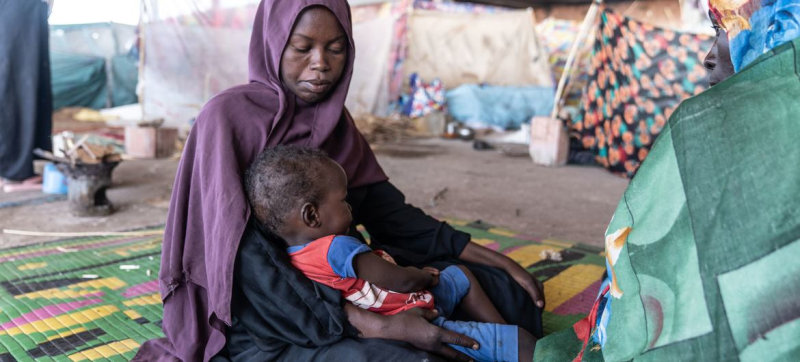
A mother looks after her child at a camp for displaced people in Gedaref, Sudan, after fleeing her home.
Famine was declared in the Zamzam camp in North Darfur one year ago. Since then, little has changed – no aid trucks have reached the region, the nearby city of El Fasher remains under siege, and food prices are four times higher than in other parts of the country.
It marks a grim milestone for Sudan, the world’s worst humanitarian crisis. But with insufficient funding, lack of access to key regions, and intensifying violence, such milestones have become the grim norm.
“This is not hypothetical. It is a looming catastrophe,” said Sheldon Yett, the UN Children’s Fund (UNICEF) representative in Sudan.
The crisis is disproportionately affecting women and children, many of whom have been displaced multiple times and lack access to even the most basic services, such as clean water, food, and protection.
“Every day the conflict continues in Sudan, innocent lives are lost, communities are torn apart, and trauma continues to haunt generations,” said Radhouane Nouicer, the UN’s designated expert on human rights in Sudan.
Children in Sudan are among the most affected – 3.2 million under-fives are projected to suffer from acute malnutrition in the next year.
On a recent trip to Jebel Aulia, a locality in Khartoum state at extreme risk of famine, Mr. Yett was horrified by what he saw.
“Many of the children are reduced to just skin and bones,” he said.
These children are not only battling malnutrition – some have been displaced four or five times, and over three-quarters of Sudanese children are out of school.
“The emotional scar tissue is massive – children don’t know where they are going next, often feeling like aliens in their own land,” he said.
He recalled speaking to one mother in Jebel Aulia whose daughter may be permanently scarred by the violence.
“Since the war started, my daughter has fallen into a state of silence, and I can feel her heart racing with fear,” she said.
As Sudan’s food insecurity crisis spirals, women and girls are the “hungriest face of the crisis,” according to Salvator Nkurunziza, the UN Women representative in Sudan.
“With conditions now at near-famine thresholds in several regions, this is not just a food crisis but a gender emergency caused by a failure of gender-responsive action,” Mr. Nkurunziza said at a Tuesday press briefing in Geneva.
A recent report revealed that women-led households in Sudan are three times more likely to face severe food insecurity than those led by men.
This is especially concerning as the death, displacement, or forced disappearance of men has left more women as sole breadwinners. In total, 75 per cent of women-led households cannot meet basic food needs.
“The data is unequivocal: female-headed households are slipping deeper into starvation, with fewer coping mechanisms, less access to income, and even more systemic barriers than last year,” the report said.
Nevertheless, Mr. Nkurunziza stressed that women are not only victims but also agents of change. Women-led organisations are on the frontlines, running soup kitchens and supporting displaced families, yet remain excluded from decision-making and exposed to undue risks.
Food insecurity and displacement are not the only challenges Sudanese people face. The human rights situation is also deteriorating, according to Mr. Nouicer, who visited Sudan in July to meet key government officials.
“I remain gravely concerned that civilians in Sudan continue to suffer widespread violations and abuses, including extrajudicial killings, sexual violence, forced displacement, and arbitrary detention,” he said.
He highlighted the unique challenges that women, children, and people with disabilities face when confronting displacement and violence.
“The ongoing war has devastated civilian lives and turned daily survival into a constant struggle.”
Mr. Yett said that during his most recent trip, he witnessed both the best and worst of humanity – the devastating impact of violence and inaction, alongside the hopeful possibilities that peace and action could bring.
“We are on the verge of irreversible damage to an entire generation of children, not because we lack the knowledge or the tools to save them, but because we are collectively failing to act with the urgency and scale this crisis demands,” he said.
The first step, he stressed, is ensuring access to regions like Zamzam, which have been cut off from aid. With the rainy season approaching – and some roads already impassable – this will become even more difficult.
Mr. Nouicer added that even if a ceasefire between the warring militaries were agreed, the scale of devastation and abuse is so extreme that Sudan’s future will require more than just peace.
“The path forward demands more than ceasefires and peace talks. It requires a sustained commitment to justice, accountability, and inclusive governance.”