

- PM Orders Faster Work on Dhaka Inner Circular Road |
- Dhaka ranks world's third most polluted city this morning |
- Houthis Claim Missile, Drone Attack on Aramco Facility |
- Four Earthquakes Rattle Bangladesh Within Four Hours |
- Clean your plate – to reduce food loss and waste |
Myanmar Conflict Directly Affecting Bangladesh Border: Minister
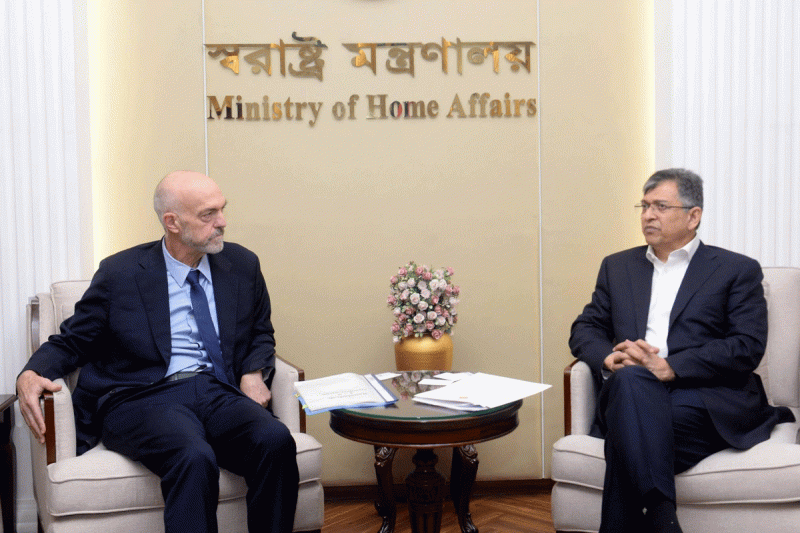
Bangladesh Home Minister Salahuddin Ahmed has said the Rohingya crisis has become increasingly complex, with the armed conflict between Myanmar’s junta forces and the Arakan Army directly affecting areas along Bangladesh’s border.
He made the remarks on Sunday during a meeting with Nicholas Koumjian, head of the United Nations Human Rights Council’s Independent Investigative Mechanism for Myanmar (IIMM), at the Home Ministry in Dhaka.
Bangladesh has sheltered hundreds of thousands of Rohingyas on humanitarian grounds, but the continuing conflict inside Myanmar has created additional security and humanitarian challenges along the border, the minister said.
The meeting discussed alleged crimes against humanity in Myanmar, a sustainable solution to the Rohingya crisis, strengthening border security and ongoing legal proceedings at the International Court of Justice (ICJ).
Ahmed said international assistance for the Rohingya response has been declining, placing additional pressure on Bangladesh. He urged the international community and UN agencies to maintain financial and logistical support for the Rohingya population at previous levels to help ensure their safe, dignified and swift repatriation.
Koumjian thanked the Bangladesh government for its continued cooperation with the IIMM. He said his team had visited Cox’s Bazar and other locations and interviewed more than 200 victims and witnesses.
According to Koumjian, the evidence collected is being shared with the International Criminal Court (ICC), the ICJ and other international tribunals as appropriate.
He said the IIMM’s work is not limited to the violence of 2017. The mechanism is also documenting recent violence and human rights violations against civilians arising from fighting between the Arakan Army and Myanmar’s junta forces.
Bangladesh Border Guard (BGB) Director General Major General Mohammad Ashrafuzzaman Siddiqui highlighted the serious threat posed by landmines reportedly planted on the Myanmar side of the border.
He said heavy rain and landslides can cause mines to move across the border into Bangladesh, putting farmers and hill communities at risk. He also briefed the meeting on measures taken by the BGB to prevent illegal crossings and on the overall border situation.
When the IIMM team expressed interest in speaking with BGB field commanders to collect information on victims who had recently crossed into Bangladesh, the Home Ministry and the BGB agreed to facilitate the discussions.
Ahmed expressed hope that the forthcoming ICJ ruling would increase international pressure on Myanmar and contribute to the eventual return of displaced Rohingyas to their homeland.