

- Integrated Ganges Management Will Save River, Benefit People |
- Net FDI in Bangladesh jumps 39.36% to $1.77 billion in 2025 |
- Bangladesh, US sign energy cooperation MoU in Washington |
- UNAIDS Warns HIV Services Face Crisis Amid Funding Cuts |
- Central Bank approves liquidation of 5 ailing NBFIs from July |
Integrated Ganges Management Will Save River, Benefit People
Farakka Long March Day Expectations
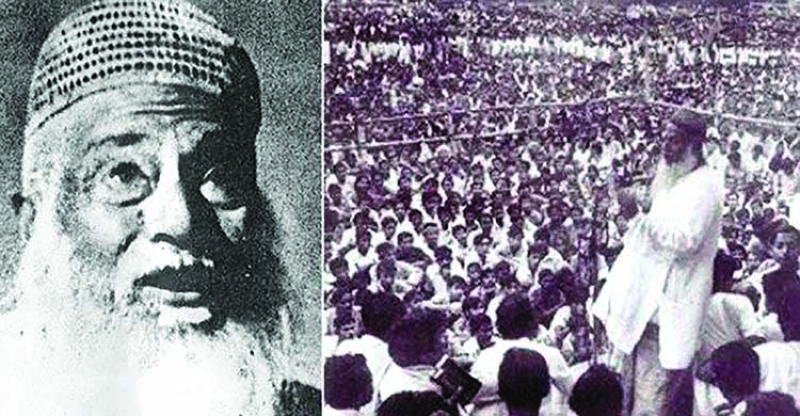
Maulana Abdul Hamid Khan Bhasani led the Farakka Long March from the Madrasah Maidan in Rajshahi on 16 May 1976.
Mostafa Kamal Majumder
The people of Bangladesh are observing the Farakka Long March Day on 16 May to commemorate the historic mass mobilisation made by Maulana Abdul Hamid Khan Bhasani, to secure water rights on the Ganges against its unilateral diversion in 1976. Its outcome was Dhaka’s raising the issue at the United Nations and under its persuasion the signing of the 1977 Ganges Water Sharing Treaty. 50 years later today the people want the 30-year Ganges Water Treaty of 1996 that will expire on 12 December next to be carried forward by a sustainable new treaty that will keep the river alive and give people along its basin services sustaining livelihoods, environmental, ecology, biodiversity and ecosystems.
Experts say, the 1996 Ganges treaty needs to be updated as it was not based on the internationally accepted norm of integrated water management giving up the faulty notion of dividing a natural water flow at the man-made political border with unprecedented environmental consequences. Expert level talks have started but their focus remain as narrow as before although human understanding of livelihoods, environment, water resources, ecology, biodiversity and ecosystems and their sustainability have undergone unprecedented changes.
Bangladesh Foreign Minister Khalilur Rahman has told Indian news outlet NDTV that a revised Ganges Water Sharing Treaty will be the first major test in rebuilding relations between Bangladesh and India, stressing that a fair and climate-resilient water sharing framework is vital for livelihoods, agriculture, and food security.
Indian foreign secretary Vikram Misri has said to a Bangladesh media team in New Delhi that water was always a priority for them among the bilateral issues as the two countries share at least 54 rivers and they have a water sharing treaty only for the Ganges.
On the other hand former Indian diplomat Pankaj Saran who was High Commissioner to Bangladesh before now heading an independent think tank NatStrat, told the Bangladesh media delegation on May 5 in New Delhi, ‘Ganges water sharing formula (in the 1996 treaty) may not work anymore after 30 years; population had grown and the water flow had decreased, which he termed as the ‘new reality’ for the renewal of the deal.
These words reflect the faulty notions on which the Ganges agreement was based. Water expert Prof. Nazrul Islam (Pen name Asif Nazrul) writes: “… The fact is that the Ganges negotiation began and continued on a faulty legal premise. It focused solely on the competing demands and uses in the downstream Ganges without linking these with the upstream uses of the river. The resulting agreements were unique in many respects. They were short-term or fixed-term, primarily centred around the Farakka project, and focused solely on the economic use of the Ganges, neglecting key environmental issues.” 1
Prof. Maniruzzaman Miah, eminent geographer and former Vice-Chancellor of Dhaka University, was first to point out this weakness of the treaty and was criticised for his alleged move to tint what was projected as a great achievement of the first Awami League government that came to power after the bloody August 1975 changes.
An illustration on this can be found in the Delhi-based Down To Earth news magazine which wrote in January 1997, “The problem of upstream use, leading to a lower quantum of water for Farakka, has for long remained unresolved. Plans are on to augment supplies to Farakka by building a 141-km long canal from the Sankosh river in Bhutan, across the northern part of West Bengal, into the Teesta River. The proposed canal project has been criticised severely on environmental grounds ( Down To Earth , Vol 5, No 14). According to West Bengal finance minister Asim Dasgupta, water would be carried from the Teesta barrage in Jalpaiguri through the Teesta canal system into Farakka.” 2
The dry season flow of the Teesta has continued to be diverted to the Ganges above Farakka under India’s River Interlinking Plan, the Teesta-dependent northern Part of Bangladesh being exposed to drought in the lean season and severe floods and riverbank erosion in the wet season. In the last wet season, the people on the Rangpur region of Bangladesh experienced more than three waves of flood from the river.
Prof. Maniruzzaman Miah’s prophesy that the treaty was no guarantee of the flow of water to Bangladesh, as apportioned, because of its lack of control over interventions at upstream of the river proved true in the very first year of its implementation in 1997 when the Ganges flow to Bangladesh came down to as low as 6,000 cusecs (cubic feet per second) against the allocation of 35,000 cusecs.
“A study comparing yearly releases from Farakka and corresponding downstream flows between 1997 and 2016 found that in around 31 percent of cases, Bangladesh received less water than expected. Such gaps have significant implications for agriculture, fisheries and ecosystems, where downstream flow is critical.
“Experts note that one of the key limitations of the treaty is the absence of a dispute resolution mechanism, as well as limited provisions for independent verification of water releases. As a result, disagreements are often prolonged through negotiations without definitive resolution.” 3
Against this backdrop, Bangladesh and India held a meeting of the Joint Committee on the implementation of the 1996 Ganges Water Sharing Treaty in Dhaka on Tuesday 10 April last, focusing on ensuring equitable water distribution during the dry season and strengthening cooperation over shared rivers.
The meeting was led by Md Anwar Kadir of the Joint Rivers Commission on the Bangladesh side and the Indian side by Sharad Chandra, Commissioner for Flood Management. As reported, both countries face increasing pressure on river systems due to climate variability, upstream challenges and growing water demand. Experts say, resolution of the issues would become easier if Integrated Water Resources Management (IWRM) promoted by water professionals worldwide is adopted and the river is transparently managed from its source up in the Himalayas in Nepal to its outfall in the Bay of Bengal in Bangladesh.
Water experts worldwide see no lasting benefits of interventions like the Farakka Barrage that has not succeeded to fulfil its primary objective of flushing silt from the Kolkata Port, and has instead exacerbated floods and riverbank erosions in Bihar prompting the longest serving Chief Minister Nitish Kumar (who resigned recently) to demand its demolition. The barrage served an unprecedented environmental disaster to South-West Bangladesh, drying up Ganges distributaries, severing the flow of fresh water and threatening biodiversity of the Sundarbans World Heritage Site for Mankind.
If the present norm of treating the river as a living entity is honoured and efficiently managed holistically to keep it alive while harnessing its services; wastage of resources can be avoided to secure a win-win situation for people living both at upstream and downstream of its basin.
The Down To Earth write-up of 1997 mentioned, “… More important is the question of augmentation of lean flow through non-structural solutions. Experience has shown that if the upstream catchment basin is properly managed through local water harvesting, watershed development and afforestation, then lean season flow can be substantially augmented. S S Sohani, commissioner, ministry of water resources, agreed that ecologically, this would be a much better way to augment the lean season flow. …” 4
The Bangladesh wing of the Joint Rivers Commission needs to give up its secrecy that hides inefficiency in dealing with the water issue and make compelling cases for Integrated Water Resources Management of the entire Ganges as well as other shared rivers. It should workout its position through appropriate national dialogues. Rivers and their water that they deal with have implications not merely for irrigation, fishery, navigation and livelihoods but also for water courses, biodiversity, ecology, environment and ecosystems that they sustain. Bangladesh, being at the lowest edge of the Eastern Himalayan river systems, is in a critical situation. It drains the entire Ganges, Brahmaputra and Meghna river basins. The country is the world’s largest delta formed by the common rivers. Without these rivers Bangladesh’s physical existence, environment, economy, ecology, biodiversity as well as ecosystems cannot survive. Water diplomacy is not a question of feeling shy while dealing with the big neighbour. It’s question of Bangladesh’s physical existence that cannot be compromised.
References:
1. https://www.thedailystar.net/slow-reads/big-picture/news/sharing-ganges-water-what-looms-after-2026-3547361
2. https://www.downtoearth.org.in/environment/finding-the-course-at-last-22969
3. https://theclimatewatch.com/ganges-water-sharing-talks-held-in-dhaka-amid-dry-season-worries/
4. https://www.downtoearth.org.in/environment/finding-the-course-at-last-22969
(An editor, writer and researcher, Mostafa Kamal Majumder now edits monthly GreenWatch news magazine and GreenWatch Dhaka online newspaper.)