

- PM off to New York to attend UNGA |
- 8 Killed in Ashulia Garment Factory Fire |
- Apratim Murder Suspects Confessed, Says Home Minister |
- Dhaka's air decorded unhealthy for sensitive groups Sunday morning |
- Meet Earth’s newest wild cat species, the first named in over a century |
Experts Warn of Stronger Cyclones and Higher Himalayan Quake Risk
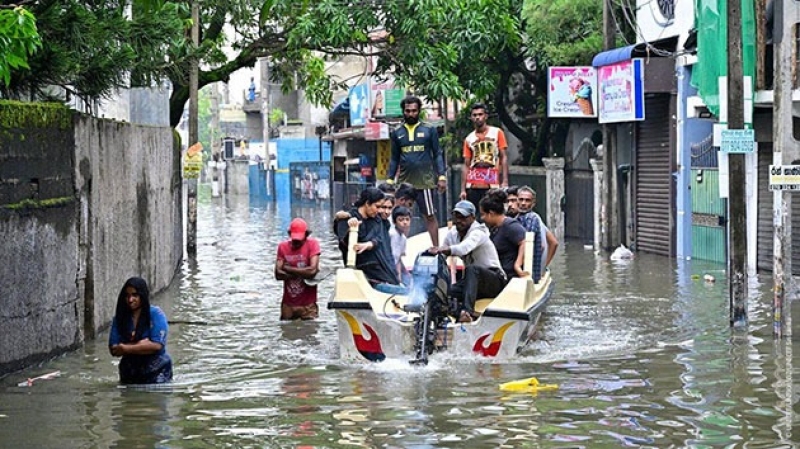
Residents travel by boat through flooded streets in Colombo after heavy rains from Cyclonic Storm Ditwah.
Despite early warnings reportedly reaching communities before Cyclones Ditwah and Senyar struck coastal regions in Sri Lanka and Southeast Asia in late November 2025, over 1,500 people lost their lives, hundreds went missing, and millions were affected by these disasters, which caused massive destruction. Scientists say these events reflect a changing climate system that is making cyclones far more hazardous than what was previously considered “typical.”
Meanwhile, Himalayan communities, already threatened by climate-driven floods and slope failures, now face major seismic risk. India recently upgraded its seismic zonation map, placing the entire Himalayan arc in the highest seismic-risk category (Zone VI). Scientists say this calls for urgent re-evaluation of infrastructure, as the combination of climate stress and tectonic hazards increases the vulnerability of around 52 million people living in the region.
A Trend of Intensifying Storms
Professor Benjamin Horton, Dean of the School of Energy and Environment at City University of Hong Kong, told IPS: “While Senyar and Ditwah are still tropical cyclones in a meteorological sense, what makes them different is their intensity, rainfall patterns, and the regions they are impacting.”
He added that warmer ocean temperatures and shifting atmospheric circulation are fueling storms that are stronger, wetter, and sometimes slower moving, leading to prolonged flooding and greater destruction. Horton emphasized the need for a multi-layered approach, including accurate forecasting, resilient infrastructure, evacuation training, natural buffer restoration, and integrating climate risks into government planning.
“Reducing greenhouse gas emissions globally is essential to slow the trend of intensifying storms. Locally, proactive adaptation and preparedness will save lives and reduce economic losses,” Horton said.
Indian climate scientist Roxy Mathew Koll highlighted that Ditwah and Senyar represent a new class of cyclones, defined less by extreme wind speeds and more by extraordinary rainfall, which exacerbates flooding.
Ligin Joseph, a physical oceanography researcher at the University of Southampton, noted that while it is too early to determine the exact role of climate change, both cyclones had unusual characteristics, including formation close to the equator and slow movement, which intensified rainfall accumulation and flooding.
Overlay of Climate Stress and Seismic Risk in the Himalayas
India’s upgraded seismic zonation has placed 61% of the country’s landmass in moderate- to high-risk zones, with the entire Himalayan arc in Zone VI. Vineet Gahalaut, Director of the Wadia Institute of Himalayan Geology, said the change is significant, requiring strengthening of all critical structures in the region.
Experts stress that development in vulnerable zones must be carefully managed, particularly for critical infrastructure such as hospitals, schools, and power plants. The National Disaster Management Authority (NDMA) warns that economic losses from earthquakes may disrupt regional and national economies, especially if megacities like Delhi or Mumbai are affected.
Scientists and disaster experts agree that the overlay of intensifying climate-driven disasters and elevated seismic hazards constitutes a “wake-up call,” highlighting the urgent need for proactive disaster-resilient policies, strict enforcement of updated building codes, and strategic planning to protect lives and livelihoods.