

- CI Launches Global Renewables Finance Readiness Index at COP31 |
- Bangladesh Targets $1 Billion in Fish Exports by 2030 |
- US Lifts Nationwide Flight Restrictions After Four Hours |
- Protecting the Climate Means Protecting Territorial Rights |
- Bangladesh Targets $1 Trillion Economy by 2034 |
Climate support must continue after LDC graduation: Speakers at COP31
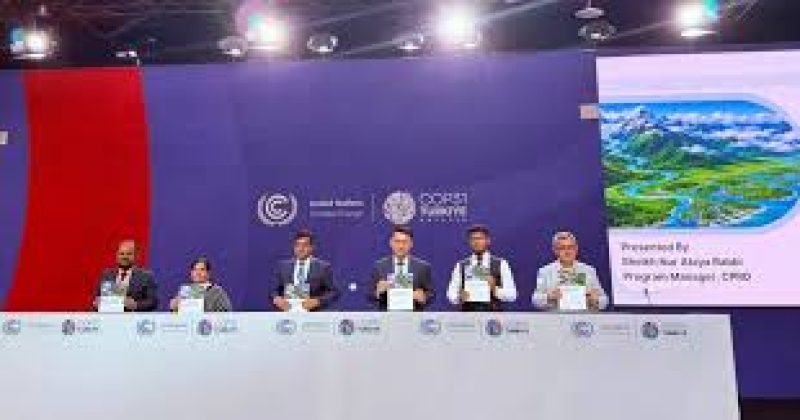
Speakers at a discussion on Saturday stressed that climate finance and international support must continue even after countries graduate from the Least Developed Country (LDC) category, warning that the withdrawal of special support could undermine their efforts to tackle climate change and build resilience.
They made the call at a press conference titled “From Shared Vulnerability to Resilience in BBN: Advancing Adaptation and Finance Priorities at COP31” at the COP31 venue in Antalya, Türkiye.
The press conference was organised by the Centre for Participatory Research and Development (CPRD) in collaboration with the Climate Justice Alliance–Bangladesh (CJA-B).
The event brought together representatives from Bangladesh, Bhutan and Nepal (BBN), climate experts and civil society actors to highlight shared climate vulnerabilities and advance a vulnerability-centred approach to adaptation and climate finance under the UNFCCC process.
The discussion highlighted that despite their different geographical and socioeconomic contexts, the three countries face interconnected climate risks through a shared mountain-to-delta system.
Himalayan glacier retreat, changing monsoon patterns, transboundary river flows, extreme weather events, sea-level rise and salinity intrusion are creating cascading vulnerabilities across the region, demanding stronger regional cooperation beyond conventional country-based approaches.
Moderating the press conference, Md. Shamsuddoha, Chief Executive of CPRD, emphasized that LDC graduation does not mean graduation from climate vulnerability.
He highlighted the differentiated yet interconnected vulnerabilities of BBN countries and called for greater flexibility in accessing international climate finance beyond LDC graduation, ensuring that development progress does not undermine their continued adaptation support.
“Graduating from LDC status doesn’t mean we’ve graduated from climate vulnerability,” Shamsuddoha said. “LDC graduation will limit our access to finance. Losing those financing options will put countries under intense pressure. Our broader concern is that adaptation support should continue for countries graduating from LDC status.”
Manjeet Dhakal, Head of LDC Support Team and Director, Climate Analytics South Asia, emphasised that BBN countries form an interconnected mountain-to-delta climate development corridor through the Himalayan range, shared water systems and the basin.
“It’s a great thing to see this alliance moving forward,” Dhakal said. “What happens in one country doesn’t stop at the border. That’s why it’s so important for us to work together. All three countries can set an example. Bangladesh is a school for climate adaptation, and the world can learn from our region’s experience in forest conservation and net zero. I’m happy we’re working together.”
Presenting the keynote paper, Sheikh Nur Ataya Rabbi, Programme Manager–Research and Advocacy at CPRD, underscored the urgency of advancing a collective BBN adaptation and finance agenda at COP31. He emphasized the need for coordinated regional advocacy and a shared narrative that recognizes the countries' differentiated vulnerabilities and interconnected climate risks.
Dr. Shah Abdul Saadi, Joint Secretary, Economic Relations Division (ERD), Ministry of Finance, Bangladesh, said climate-related weather events are becoming more frequent, intense, persistent and unpredictable.
He called for civil society organizations to work across borders to build evidence, influence climate policy and develop early warning systems that work across countries and reach vulnerable communities. He urged countries to mobilize finance and technology quickly and at scale.
“Vulnerability is common, so responsibility should be shared,” Saadi said. “As we know, access to concessional finance will be limited, and debt servicing is putting pressure on our budget. That’s why civil society organisations need to come together and use their collective voice to influence how resources are allocated.”
Md. Ziaul Haque, Additional Director General (PRL), Department of Environment, Ministry of Environment, Forest and Climate Change, Bangladesh, stressed that LDC graduation reflects development progress, not the disappearance of climate vulnerability.
He called for stronger links between adaptation priorities and climate finance under the UNFCCC, protecting grant-based support based on forward-looking vulnerability and fiscal capacity.
He further emphasised that finance must remain accessible after graduation and reach nationally identified, cost adaptation priorities on appropriate terms, supported by coordinated BBN advocacy and practical regional cooperation.
“In 2024, Bangladesh proposed forming this coalition. Over the past two years, we’ve made joint submissions,” Haque said. “When a disaster happens upstream, it can directly affect Bangladesh downstream. This initiative should receive more international support to address loss and damage and help our countries adapt.”
Ruchi Chaudhary, Programme Manager, Climate Action Network South Asia (CANSA), stated “Graduating from LDC status doesn’t mean our vulnerabilities go away. Bhutan faces melting glaciers, Nepal faces unpredictable weather, and cyclones put lives and livelihoods at risk. LDC graduation can mean losing access to concessional finance. Climate risks are increasing, but support is decreasing.
“At COP31, from LDCs, we have three demands. First, we need more adaptation finance. Developed countries should provide predictable, grant-based finance. Vulnerable countries should not have to take on more debt.
“Second, GDP or LDC status alone cannot tell us how vulnerable we are or what it costs to protect people. Finance must reach local governments and communities.
“Third, LDC graduation must not mean international support ends overnight. The vulnerabilities of Bangladesh, Bhutan and Nepal must be recognised. Climate justice cannot come with expiry dates. Bangladesh, Bhutan and Nepal are asking for fairness and resources, not charity. COP31 must turn promises and solidarity into action.”
The press conference identified three key policy demands for BBN countries to advance at COP31 and beyond:
1. Prioritize Vulnerability-Centred Adaptation: Keep adaptation central to global climate negotiations, guided by vulnerability, equity and human rights, while recognizing the differentiated yet interconnected climate risks across BBN countries.
2. Ensure Adaptation Finance Beyond LDC Graduation: Establish forward-looking financing arrangements that guarantee continued access to adequate, predictable, accessible and grant-based adaptation finance, reflecting countries' actual and projected vulnerabilities, national adaptation needs and fiscal capacities.
3. Strengthen Coordinated BBN Action: Advance a common regional advocacy and negotiating agenda among Bangladesh, Bhutan and Nepal, recognizing their shared transboundary climate risks and strengthening cooperation on early warning, locally led adaptation, transparent finance delivery and accountability.
The programme concluded with a call for BBN governments, civil society organizations and international partners to work collectively towards an equitable global adaptation framework that recognizes climate vulnerability beyond development classifications.
Participants said that development progress must not become a barrier to accessing the finance and support necessary to build resilience and secure sustainable futures, reports UNB.