

- PM to address UNGA in Bangla today |
- UNGA President Warns Against Fading Attention to Rohingya |
- PM Proposes Five Urgent Steps to Resolve Rohingya Crisis |
- Govt Appoints Indonesian Firm to Operate Cox’s Bazar SPM |
- ADB lowers Bangladesh’s growth forecast to 4 % in FY2027 |
Strong El Nino to dominate global climate in late 2026: WMO
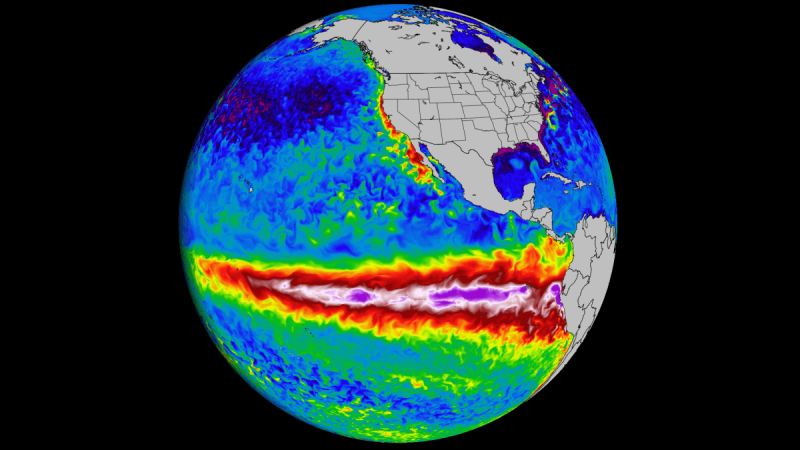
Latest forecasts show a Super El nino event is developing.
Penang, 4 Aug (Kanaga Raja) — El Nino is strengthening steadily and is expected to dominate global climate patterns in the August-October 2026 season, increasing the likelihood of above-normal temperatures across much of the world and triggering major shifts in rainfall patterns, the UN World Meteorological Organization (WMO) has warned.
Combined with exceptionally warm global oceans and the likelihood of a positive Indian Ocean Dipole, the developing El Nino is expected to shape weather patterns across many parts of the world in the months ahead, it said in a press release.
“El Nino is not just on our doorstep – it is inside the house and turning up the heat. And this is only a warm-up act. El Nino is strengthening – adding fuel to a planet already on fire with scorching heat domes, apocalyptic wildfires and record hot seas,” said UN Secretary-General Antonio Guterres.
“Fossil fuels are fanning the flames of this crisis. Expansion must stop. More coal, oil and gas will lead to a more combustible future,” he added.
“Unless we act – to protect people and tackle the root cause of the crisis – the dangers will become deadlier still. The warm-up act is over. We cannot afford to wait for the main event,” the UN chief warned.
“El Nino is one of the most closely monitored climate phenomena in the world. But forecasts in themselves do not prevent hazards, people do,” said WMO Secretary-General Celeste Saulo.
“This El Nino developing against the backdrop of unprecedented ocean heat and rising temperatures, provides governments and communities with a window of opportunity to anticipate risks and act before impacts unfold,” she added.
“The decisions we make today will shape the impacts we experience tomorrow. WMO and its Members are committed to ensuring that credible and relevant climate information reaches those that need it most,” she said.
WMO’s Global Seasonal Climate Update indicates that El Nino will continue to steadily intensify into a strong event during August-October 2026.
Multi-model ensemble forecasts from leading global producing centres indicate that seasonal-average sea-surface temperature anomalies are expected to exceed 2.9 degrees C in key monitoring regions, said WMO.
In addition to a strengthening El Nino, a positive Indian Ocean Dipole (a climate pattern in the western Indian Ocean becomes warmer on average, while the eastern Indian Ocean becomes cooler than average) is forecast.
The UN weather agency said together, these oceanic drivers can amplify regional climate impacts including drought, floods and wildfire risk, particularly around the Indian Ocean basin.
It further said that tropical Atlantic sea surface temperatures are also expected to remain warmer than average.
According to WMO, its Global Seasonal Climate Update predicts an overwhelming likelihood of above-average temperatures across most land areas.
For the August-October 2026 season, multi-model ensemble (MME) forecasts project a nearly universal global dominance for enhancement in probabilities for above-normal temperatures over landmasses.
The report said that in the northern hemisphere, a large increase in probabilities for above-normal temperatures covers Africa, southern Europe, the Arabian Peninsula, the Indian Subcontinent, eastern Asia, western parts of North America below 60 degrees N, Central America, and the Caribbean.
It said that model consistency across these regions is moderate to strong. Conversely, a weaker enhancement in probabilities of above-normal temperatures is indicated over parts of northern Asia, as well as northwestern and eastern regions of North America.
Meanwhile, the report said in the southern hemisphere, a strong enhancement in probabilities for above-normal temperatures is centered over southern Africa, between the equator and 30 degrees S over South America, and across New Zealand, supported by strong model consistency.
Over Australia, a moderate increase in the probability for above-normal temperature is forecast across southern and central parts of the continent, with a noticeably weaker signal present over far northern regions, it added.
In the tropics, a large increase in probabilities for above-normal temperatures covers equatorial Africa, South America, and the northern part of the Maritime Continent.
WMO said that over the ocean basins, forecasts reflect a footprint of the rapidly intensifying El Nino event.
The report said that extreme probabilities (exceeding 80%) for above-normal sea surface temperatures (SSTs) dominate the equatorial Pacific east of the Date Line, where the core of the warm region displays maximum model consistency.
A widespread tendency for above-normal temperatures also covers the Indian Ocean and the tropical Atlantic, WMO reported.
In contrast, a region of below- to near-normal temperature probabilities is predicted across the North Atlantic.
According to the report, a zone of enhanced probabilities for below-normal temperatures is centered in the South Pacific sub-tropical region (between 10 degrees S and 30 degrees S), supported by strong model consistency.
More importantly, WMO said the August-October 2026 rainfall outlook exhibits patterns of a classic, strong El Nino event.
For the August-October 2026 season, MME forecasts project well-structured, large tilts in rainfall probabilities, exhibiting a classic, strong atmospheric response to Pacific El Nino, it added.
The report said the most dominant feature of the outlook is a strong enhancement in the probability for above- normal rainfall stretching across the central and eastern equatorial Pacific east of the Date Line, backed by strong model consistency.
The core for this rainfall signal is flanked by an extensive region of below-normal rainfall probabilities, it noted.
WMO said this broad dry signal encompasses widespread marine zones, manifesting as strong enhancements in the probability for below-normal rainfall over both the tropical Indian Ocean and the equatorial Atlantic Ocean, as well as a horseshoe pattern extending into the Northern and Southern Hemispheres starting at around 120 degrees E.
“The Indian Subcontinent features an enhancement in the probability for below-normal rainfall, exhibiting high model consistency across the region.”
WMO said that to its northwest, there is an enhancement in probabilities for above-normal rainfall extending into parts of Central Asia and northern regions of the Arabian Peninsula.
Across equatorial Africa, the Greater Horn of Africa shows an enhanced probability for above-normal rainfall, with an enhancement in probability for below-normal rainfall to its west.
Flanking this equatorial belt, a weak enhancement in the probability for above-normal rainfall is indicated over both the far northern and southern parts of Africa, it added.
Over Australia, an enhancement in the probability for below-normal rainfall dominates over the southern and eastern regions, with strong model consistency.
Over North America, there is an enhancement in the probability for below-normal rainfall covering the southern parts of Central America and the Caribbean, supported by high model consistency, said the UN weather agency.
To its north, there is an enhancement in the probability for above-normal rainfall over the western parts of North America below 45 degrees N.
In South America, a robust enhancement in probability for below-normal rainfall is centered over the northwest, continuing steadily along the northern coastal areas to the east, said WMO.
“Farther south, a branch of enhanced probability for above-normal rainfall extends across southeastern South America.”
Meanwhile, WMO said across Europe, the MME forecasts reveal a notable latitudinal split. An enhancement in the probability for above-normal rainfall covers the southern parts of Europe, whereas an enhanced probability for below-normal rainfall is predicted across northern Europe, with the consistency being low to moderate.
WMO said it is intensifying its mobilization of information and support services to help countries anticipate and minimize the impacts of El Nino. – Third World Network