

- Muslim League leads new electoral alliance, Jatiya Muslim Jote |
- Tk 500cr Drive to Turn Haor Fallow Land Into Farmland |
- Tarique Rahman returns home amid rapturous reception |
- Home After 17 Years: Tarique Returns to Gulshan Residence |
- Tarique Calls for United Effort to Build a Safe Bangladesh |
Children's addiction to digital games increasing
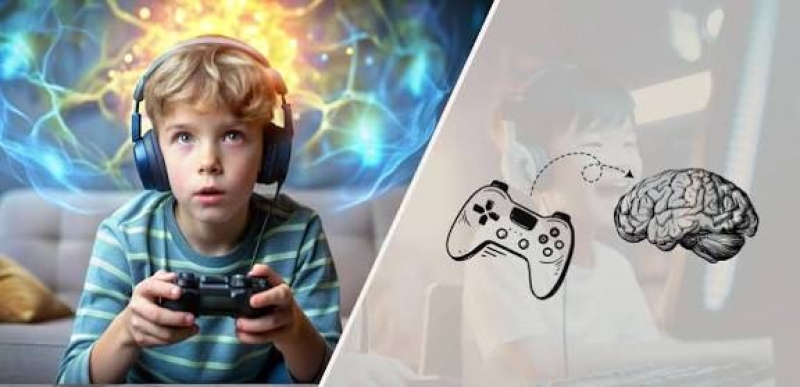
Jewel is four years old. Ratul is six. They are two brothers and they have one sister. The youngest sister is two years old. Rabeya Akhter's life is in a state of chaos as she has to raise these three children. When one wants to eat, the other goes to the toilet. Another drops something and breaks it.
In this situation, her sister-in-law, who lives in Australia, has brought two tablets for her two sons. Now the two brothers play games in it all the day long. They download new games. When the game is over, they also fight like games.
Rabeya’s life seems to have returned to normal. Although eating, sleeping and reading are delayed, the two brothers no longer cause her the same pain as before. Sometimes, even though her father-in-law scolds her for playing too many games with her children, she does not get angry.
Nidhi Akther works in a private institution, and her only daughter, Ruhi, is studying in Standard Five at an English medium school. She stays alone at home most of the time.
So she has to be busy playing games on her mobile phone even in the presence of her parents.
Nidhi said, there is no other way. “We husband and wife both cannot give her much time every day. We cannot enroll her in Shishu Academy or Chhayanaut due to lack of time. There is no playground where she can play. So she is forced to play digital games on her mobile phone.”
When asked if she notices any difference between her daughter's childhood and her own, Nidhi said, of course, reality is more important than her emotions. She is self-centered, she added.
Nidhi also plays games on her mobile phone when she is bored on the way, in between work. That is why she does not forbid girls. However, she gives great importance to education. They have to stay at home for their daughter's safety. Since she is a working woman, her children have chosen to play games on their mobile phones for entertainment.
In this way, almost everyone is busy playing digital games with smartphones, iPhones, and tabs.
American clinical psychologist Dr Nicholas Cardarus has termed this type of addiction as ‘digital addiction’.
In the past few years, the all-consuming grip of digital addiction has increased in our society.
The harm of these digital devices has been scientifically proven. This harm is even greater for young children. If you look at the street or at school, you can see that many children have problems with their eyes. They have to use glasses since childhood. In most cases, the reason is digital addiction.
According to the information of the Pediatric Department at Islamia Eye Hospital in Dhaka, eye problems in children aged 8 to 14 are increasing.
Doctor's examinations, patients and parents have revealed that problems are caused by excessive playing of games on mobile and computer and watching TV in children's eyes.
The doctor's advice to all parents with prescriptions is to keep children away from mobile, computer and TV.
Many people are consciously or subconsciously stuck on Facebook for no reason in the office or at home, and children are playing games or getting addicted to pornography.
Department of Child, Adolescent and Family Studies at the National Institute of Mental Health Professor Helal Uddin Ahmed said that most of the video games that children like nowadays involve violence, fighting, war, possession, etc.
He said that digital games have a mental, physical and social impact on children. First, they get headaches. Eye problems appear, and problems with the spine appear. Secondly, children are affected by violence in these games and most of the time they want to win, he added.
He said they do not have the mentality to accept or tolerate defeat. As a result, they may decide to end themselves because they cannot tolerate defeat. They do not develop socially.
He said that they grow up to be self-centered which can act as an obstacle in the path of developing human values in a child.
The doctor said that such addictions are destroying the social skills of children. He talked about children's sports and innocent entertainment.
A survey by the ‘Work for Better Bangladesh Trust’ found that 64 percent of schools in Dhaka do not have any sports classes, most schools do not have playgrounds, 67 percent of children do not have any opportunities to play sports near their homes, 37 percent of children play indoors, 29 percent of children do not play any sports, and 47 percent of children spend an average of three hours or more a day watching television.
The horrific consequences of mobile phone, internet and gadget-based entertainment for children have been revealed in a survey conducted by the 'Manusher Jonno Foundation'.
It showed that about 77 percent of school-going children in Dhaka watch pornography.
For this reason, Dr Helal said that mothers have a special role to play in this regard. They should tell stories. They should be associated with painting, singing, dancing, etc.
He emphasized on providing safe entertainment for children, including playgrounds and walks in the city.
He believes that if children are given enough time and kept busy with sports that develop their physical and mental development, it is possible to reduce their addiction to technology and the internet to a great extent, reports BSS.