

- PM calls FY27 budget 'life-friendly', promises relief |
- Govt Backs Off Package VAT After Business Outcry |
- Power Outages Continue to Disrupt Life in Sylhet |
- PM Tarique Makes Surprise Visit to SPARRSO |
- Argentina Beat Jordan 3-1 to Top Group J |
PM calls FY27 budget 'life-friendly', promises relief
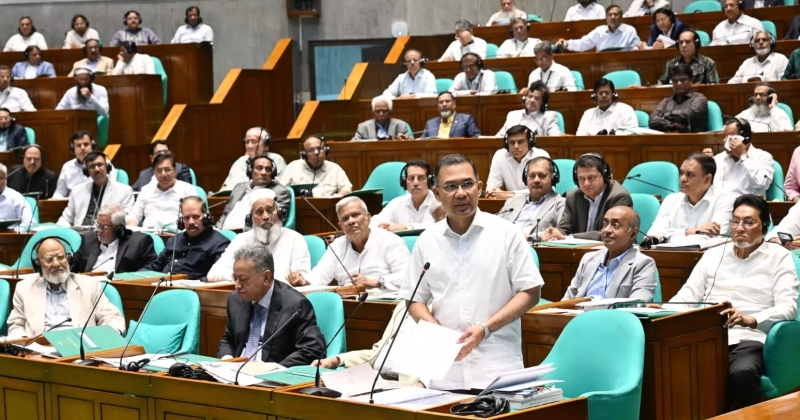
Prime Minister Tarique Rahman on Monday described the proposed national budget for FY2026–27 as a “life-friendly” plan, saying it was designed to bring relief to people from all walks of life while addressing economic challenges inherited by his government.
Speaking during the general discussion on the budget in Parliament, he said the government had placed a realistic and people-oriented fiscal plan that helped keep prices of daily essentials stable after its presentation, unlike previous years.
“I would like to call this a ‘Jibon Bandhob Budget’ (life-friendly budget). Using our highest wisdom, conscience and knowledge, we have tried to present a budget through which people of all classes and professions can find at least some relief and comfort,” he said.
The parliamentary session began at 10:30am with Speaker Hafiz Uddin Ahmed in the chair. Opposition Leader Shafikur Rahman spoke earlier in the budget debate before the Prime Minister addressed the House as Leader of the House.
Describing the budget as a key instrument of state policy, he said the government had tried to ensure a practical and balanced financial framework. “It is not possible to solve every problem overnight. Still, we have tried to prepare a budget that offers relief across all sectors,” he said.
He highlighted that taxes and duties on 61 essential commodities had been withdrawn to ease pressure on consumers. He also said the country did not witness abnormal price hikes around the budget period this year.
“We believe the withdrawal of taxes on essential goods has helped us fulfil part of our responsibility to the people,” he added.
Acknowledging that no budget can meet every expectation, he said the government had considered ground realities and competing demands while preparing the fiscal plan.
The Prime Minister also spoke about the economic condition inherited when the government assumed office on February 18, saying the economy was marked by corruption, mismanagement and financial instability.
He alleged that large-scale capital flight, falling investment and high inflation had severely affected the economy. “Thousands of crores of taka were siphoned out. Investment and production had nearly stagnated,” he said.
He further noted stress in the capital market, saying many investors had lost savings and some had been driven to extreme distress, while foreign exchange reserves were under pressure due to capital flight and wasteful spending.
Referring to major infrastructure projects of the previous administration, he said many had become financial burdens due to heavy borrowing and low returns.
Finance Minister Amir Khosru Mahmud Chowdhury had placed the FY2026–27 national budget on June 11, proposing a Tk 9.38 lakh crore outlay aimed at curbing inflation, reducing living costs, boosting investment, expanding social protection and maintaining fiscal discipline.
The Prime Minister said the government did not deny the challenges but would not use them as an excuse for inaction. He expressed confidence that the country would gradually overcome its economic difficulties through political commitment and effective policies.