

- World Food Day Observed Today Amid Global Hunger Crisis |
- World Lost More Than 7 Million Hectares of Forest in 2025 |
- Bangladesh Ranks 84th in Global Hunger Index 2026 |
- 10 Die of Dengue in Bangladesh, 1,943 Hospitalised |
- 28 Killed as School Roof Collapses in Northwest Pakistan |
Biodiversity Targets Lag as UN Warns of a War on Nature
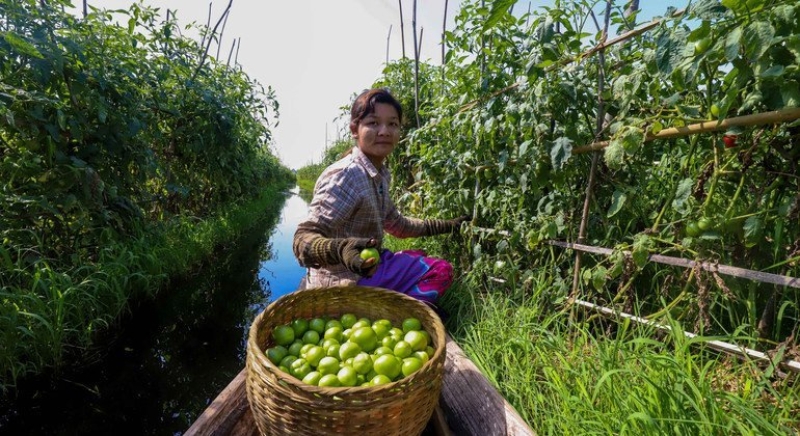
A farmer grows tomatoes on a floating plantation on Inle Lake, Myanmar.
The world is falling behind on global biodiversity targets, with fewer than half of national commitments on track to protect plants, animals and ecosystems, according to a new UN report released ahead of the COP17 biodiversity conference in Yerevan, Armenia.
The Kunming-Montreal Global Biodiversity Framework, adopted in 2022, set a vision of living in harmony with nature by 2050, with urgent action required by 2030. However, the latest assessment indicates that progress remains insufficient to meet key targets.
“Biodiversity underpins life on Earth,” UN Secretary-General António Guterres said in the report, stressing that protecting biological diversity is essential for the planet’s health, economic resilience and human wellbeing.
Progress falls short of 2030 goals
One of the framework’s central targets is to protect at least 30 per cent of the world’s land, inland waters, coastal areas and oceans by 2030.
However, even if existing commitments are fulfilled, only 26 per cent of land and 12 per cent of the ocean are expected to be protected by the deadline, the report found.
Progress is also lagging in financing, skills development, international cooperation and data collection. The report highlighted the need to reform economic incentives so that protecting nature is rewarded rather than activities that damage it.
“The war on nature has not yet ended,” Guterres warned at the report’s launch in Yerevan, pointing to the interconnected crises of climate change, biodiversity loss and pollution.
Some progress despite major gaps
The report also noted advances since the global framework was adopted in 2022.
Nearly 90 per cent of countries that are parties to the Convention on Biological Diversity have established national biodiversity targets, while more than half have developed plans to implement them. More than 70 per cent have measured and reported on their progress.
Indigenous Peoples, local communities, regional and city authorities, charities and businesses have also made around 5,000 commitments to support biodiversity protection.
However, the report warned that a substantial gap remains between announced ambitions and concrete action.
Funding and stronger policies needed
Closing that gap will require significantly greater financial support and technical expertise for developing countries, the report said.
Governments need to eliminate subsidies that harm nature, strengthen social protection, redirect public spending towards conservation and work with businesses to establish robust disclosure requirements.
The report also called for better coordination among governments, businesses, civil society, young people, women and Indigenous Peoples to improve accountability, enforcement and cooperation.
“Biodiversity must be part of every decision being made – across policies, regulations and budgets,” Guterres said, warning that good intentions alone would not be enough to protect nature.
Source: UN News