

- Egrets reappear along Buriganga after many years |
- 63 students fall sick for fire at N’ganj Madrasha; 4 at ICU |
- Dhaka Ranks 10th Among World's Most Polluted Cities on Tuesday |
- Trump says he believes war with Iran is militarily 'effectively over' |
- Government Seeks Hasina’s Return Under Extradition Treaty |
Art Dhaka 2026: Meet the visionaries who made it happen
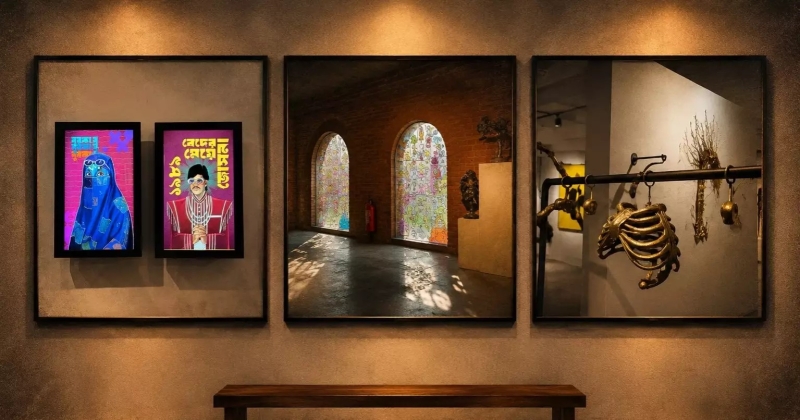
Exhibits on display at Art Dhaka 2026.
Dhaka, Nov 9 – Dhaka has long hosted art exhibitions at various venues and these initiatives have long been part of Dhaka's cultural landscape. The inaugural Art Dhaka, however, has brought a new dimension to the city's art scene.
Art lovers are not only buying tickets to enter the event but are also purchasing artworks, an emerging trend that has drawn attention. UNB takes a closer look at the initiative through the perspectives of its four co-founders, four curators and the architect behind the fair.
Held at Aloki from November 6 to 10, Art Dhaka, an Art Fair & Cultural Platform has brought together more than 135 artists through curated exhibitions, installations, printmaking and interactive spaces. Its organisers describe it as an effort to create a platform where art can be experienced, discussed and collected.
For Durjoy Rahman, founder of Durjoy Bangladesh Foundation (DBF) and a co-founder of Art Dhaka, the significance of the fair lies in developing a stronger ecosystem for visual arts in Bangladesh. He said the initiative was not intended to compete with existing art organisations or platforms but to complement their efforts and create more opportunities for artists, collectors and audiences.
"We are not comparing ourselves with anyone," Durjoy told UNB. "Everyone who has contributed to the promotion and growth of visual arts in Bangladesh deserves due respect. This is not a market where we need to see others as competitors. Rather, we are working towards developing the ecosystem,” he said.
Co-founder Nahar Khan, Executive Editor of UNB and Founder of Solis, said the long-term ambition was to build an inclusive cultural infrastructure around such initiatives.
“Developing inclusive cultural infrastructure requires more than creating spaces for art. It requires cultivating an entire ecosystem around it,” she said, pointing to the importance of patronage, education, community engagement and audience development.
Fahd Sattar, the Founder & CEO of Aloki and one of the four Co-founders of Art Dhaka, highlighted Aloki's role in shaping that experience. The venue, developed as a space for events, creative activities and public engagement, offered an opportunity to bring different forms of art and audience interaction under one roof. The fair's layout, including its exhibition areas, Pavilion, Glasshouse and Print Pavilion, was designed to make the visit more than a conventional gallery experience.
“An art fair is not only a place for buying and selling. People also come here for an experience,” Fahd said, adding that the venue allowed the organisers to combine exhibitions with immersive installations, discussions, performances and other activities.
The other Co-founder, Aumia Khundkar who is the Managing Editor of ICE Today, ICE Business Times and is associated with Dhaka Makers, focused on how the overall initiative reached its audiences.
She said the fair brought together artists at different stages of their careers, including practitioners whose work had not received much exposure among local audiences. The response, she said, was visible in the range of ways visitors engaged with the event.
“We have seen many people viewing, buying and enjoying the artworks. Those who are not buying original works are collecting merchandise or print editions, while others are simply coming to see and appreciate the works. That was also part of our intention,” she said.
The idea, she added, was to make the fair welcoming to both established collectors and people encountering the art market for the first time.
The curatorial sections gave the fair its distinct artistic character. Mustafa Zaman, curator of ‘Leaping Across Time’ at the Glasshouse, also contributed to the initial planning of Art Dhaka before stepping back to allow the appointed curators to work independently. He said creating new buyers for art was an important consideration in developing a market-oriented art fair.
“One of the important objectives was to create new buyers for art,” he told UNB. While acknowledging that the first edition had its limitations, he viewed the initiative as a positive development for the city's art scene.
Zihan Karim, curator of ‘Narration. Thought. Chronicles.’, brought together 42 artworks, including four sculptures and installations outside the exhibition floor. His selection sought to reflect the range of materials and approaches used by Bangladeshi artists, with the arrangement developed in relation to the exhibition space and its architectural features.
“I wanted to bring together the diversity of materials and practices that Bangladeshi artists have been exploring over the years,” he said.
In ‘The Still Point’, curator Najmun Nahar Keya focused on artists who have sustained their practices despite personal and economic challenges. The section brings together works across different media, including painting, drawing and works using unconventional or reused materials. Inspired by a poem by TS Eliot, its title refers to the moment of concentration artists find in their studios.
“I wanted to select artists who have continued their studio practices despite economic and personal challenges,” she said.
The Print Pavilion, curated by Fareha Zeba, garnered massive attention from the fairgoers. Drawing on her experience of working with printmaking initiatives for nearly 14 years, she highlighted printmaking as both an artistic practice and a more accessible way of collecting art.
A total of 170 works by 100 artists were selected in this section, from more than 300 submissions. With prices starting at Tk 5,000, the pavilion also features demonstrations using two presses to familiarise visitors with the process.
“One of our main objectives was to make artworks available at affordable prices to the general public, art collectors and art lovers,” she said.
The fair's architectural language also draws on local references. Architect Rashed Chowdhury said the Pavilion was designed to move beyond the conventional white-cube approach and establish a brick-based setting, rooted in Bangladesh's cultural and architectural heritage. Its references include Paharpur, clay stoves and Jamdani patterns, while the brick structure can be dismantled and reused after the event.
“If we want to tell our own story, the architecture of the exhibition must also provide a context for that story,” Rashed Chowdhury said.
As its inaugural edition draws to a close, Art Dhaka leaves behind a larger question about the future of the country's art scene: how to make art more accessible, encourage a stronger culture of collecting and create sustainable opportunities for artists.
For its founders and curators, the fair is a starting point in that journey, with the hope that it will continue to grow as a platform connecting artists, collectors and wider audiences. - UNB