

- Thousands of tourists flock to Kuakata during Eid festival |
- 45th anniversary Ziaur Rahman's death Saturday |
- India’s Muslims denied public spaces for Eid prayers |
- China steps up efforts to protect rare golden monkeys at world heritage site |
- Russia urges US, Iran to avoid return to war amid nuclear tensions |
Dhaka ranks world’s 8th most polluted city Friday morning
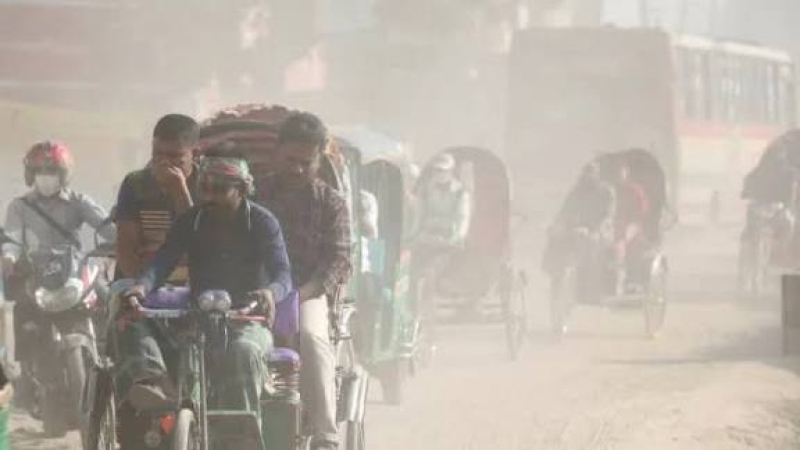
Dhaka, the capital of , ranked eighth on the list of the world’s most polluted cities on Friday morning, recording an Air Quality Index (AQI) score of 99.
According to the AQI index, the city’s air quality was categorised as ‘Moderate’ at 11:50am.
in the topped the pollution list with an AQI score of 156, followed by in with 129 and in with 126.
An AQI score ranging from 101 to 150 is considered ‘unhealthy for sensitive groups’, while a reading between 151 and 200 is labelled ‘unhealthy’.
AQI values between 201 and 300 are regarded as ‘very unhealthy’, whereas readings above 301 are classified as ‘hazardous’, indicating serious health risks.
The AQI serves as a daily measure of air quality, indicating how clean or polluted the air is and the potential health effects associated with it.
In Bangladesh, AQI calculations are based on five key pollutants — particulate matter (PM10 and PM2.5), nitrogen dioxide, carbon monoxide, sulphur dioxide and ozone.
Dhaka has been grappling with air pollution for years. The city’s air quality generally deteriorates during winter and improves during the monsoon season.
According to the , air pollution is responsible for nearly seven million deaths globally every year, primarily due to stroke, heart disease, chronic respiratory illnesses, lung cancer and acute respiratory infections, reports UNB.