

- GK irrigation pump station being redesigned as Ganges water levels fall |
- New School Curriculum to Launch in 2028 |
- Iran Halts Israel Strikes, Warns of New Action |
- Bangladesh Trade Deficit Rises $8bn in Five Years |
- New BSEC chairman commits to IPO reform, digitalisation |
GK irrigation pump station being redesigned as Ganges water levels fall
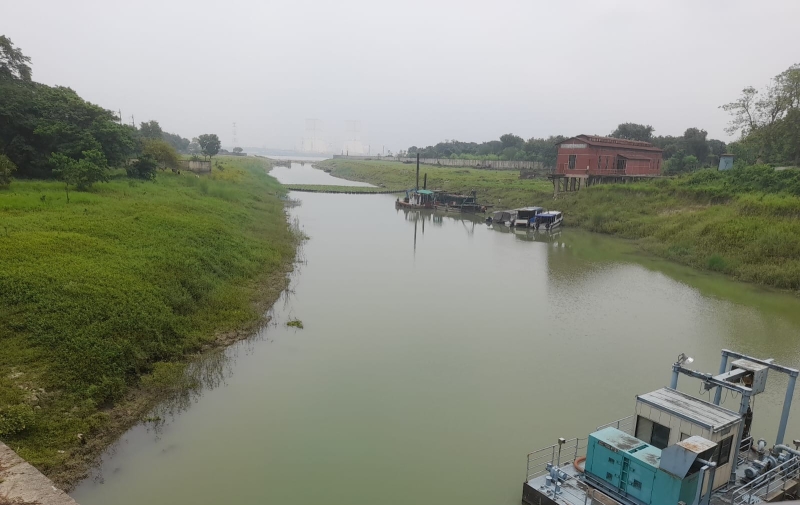
The intake canal of the Ganges Kobadak Irrigation Project pump station. Photo GreenWatch Dhaka
Kushtia, June 7 -Bangladesh’s largest surface irrigation scheme, the Ganges-Kobadak (GK) Irrigation Project, has undertaken a major redesign of its pumping system to enable water withdrawal from the Padma River at lower water levels, amid concerns over dry-season flow reductions linked to upstream diversion.
Under the redesign, the project aims to reduce the minimum water level required at its intake channel from 3.9 metres to 2.5 metres, allowing pumps to remain operational even when river levels fall significantly during the lean season, Executive Engineer of the GK Project Pump House Mizanur Rahman told UNB.
The GK Project, which has a command area of 197,500 hectares and an irrigable area of about 95,500 hectares, was launched in 1962 and remains one of Bangladesh’s most important irrigation infrastructures supporting agricultural production in the southwest region.
Its coverage however over the years came down to 55,000 hectares as some pumps and canals became inoperable.
According to project officials, the pumping station faces operational disruptions whenever the water level in the Padma River falls below 4.5 metres.
The situation worsened after the commissioning of India’s Farakka Barrage in West Bengal in 1975, which significantly altered dry-season water flows in the river system.
Mizanur Rahman said the consequences became particularly evident in 2024 when irrigation activities under the project came to a complete halt because the pumping station could not lift water after the water level in the Padma River near Hardinge Bridge dropped below four metres.
“The pumps were unable to operate, leaving the project area without irrigation support,” he said.
The redesign project is scheduled for completion in 2029 at an estimated cost of Tk 1,200 crore.
The initiative is expected to enhance the project’s resilience to seasonal water shortages by enabling water extraction at lower river stages.
However, he cautioned that engineering solutions alone may not be sufficient if the flow of the river doesn't remain steady.
“Even if we succeed in lowering the minimum operating level by around 1.5 metres, the benefit could be limited if adequate water does not continue to flow from upstream,” he said.
The GK Project occupies a unique place in Bangladesh’s agricultural history. Initial surveys for the scheme were conducted in 1951 and implementation began in the mid-1950s.
Designed as a lift-cum-gravity irrigation system, the project pumps water from the Ganges and distributes it through an extensive canal network across parts of Kushtia, Chuadanga, Jhenaidah and Magura districts.
It played a pioneering role in expanding irrigated agriculture and increasing crop production in southwestern Bangladesh.
Over the decades, however, the project has faced growing operational challenges due to declining dry-season flows in the Ganges.
Experts have long pointed to reduced upstream water availability, sediment accumulation in the intake channel and aging infrastructure as key constraints affecting its performance.
Studies and historical records indicate that the project’s pumps were originally designed for river condition that no longer exist during many dry-season months.
Sayed Tipu Sultan, Chairman, International Farakka Committee, who led a team of journalists on a trip to Kushtia and Rajbari, heavily dependent of the Padma water, said the Ganges water sharing issue should be taken to the United Nations if it is not mutually solved.
The project’s irrigation network includes hundreds of kilometres of canals and drainage channels, making it a critical component of food production and rural livelihoods in the southwest.
Water from the system supports cultivation of rice and other crops across a vast agricultural region.
As Bangladesh continues to grapple with climate variability, upstream water management challenges and growing irrigation demand, the future of the GK Project is likely to remain closely tied to broader regional water-sharing dynamics. - UNB