

- PM Opens July Memorial, Renovated Osmani Udyan in Dhaka |
- SPM Contract Cost Rises by $31m Despite Tender Rules |
- Cabinet Approves Secretariat Relocation to Sher-e-Bangla Nagar |
- Nearly Half of Bangladesh’s Families Are in Debt: BBS |
- Bangladesh Seeks Details on Execution of Two Nationals |
Pay Scale Push Sans Funding Plan Alarms Economists
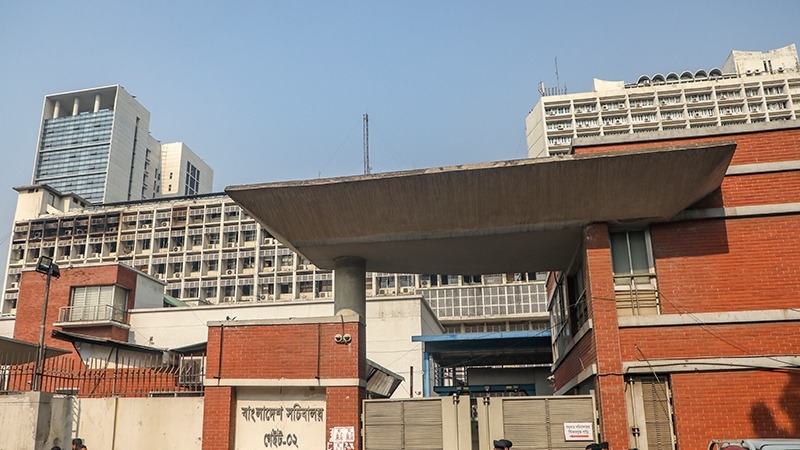
Bangladesh Secretariat - the seat of power of the government.
Special Correspondent
The government is moving towards announcing Bangladesh’s long-awaited Ninth National Pay Scale, potentially as early as the second week of September, but serious questions remain over whether the necessary funds have been secured to implement it without worsening the country’s already strained fiscal position.
Issuing the gazette is expected by September, with the new structure to take effect retrospectively from July 1. Government employees could start receiving salaries under the revised structure from October, while arrears for July, August and September may be paid in phases.
Table showing pay hike of government employees from graade 1 to 20.
However economists have warned that announcing a large and permanent increase in public-sector wages without first establishing a credible financing plan could create substantial pressure on the budget, increase government borrowing and potentially fuel inflation.
The concern is particularly significant because the government is already facing a large budget deficit, ambitious revenue targets, rising debt-servicing costs and heavy fiscal commitments in the energy sector.
The Ninth Pay Commission had proposed raising the minimum basic salary from Tk 8,250 to Tk 20,000 and the maximum from Tk78,000 to Tk160,000. Depending on the grade, the proposed increases range from around 100% to 142%.
The commission estimated that full implementation would require an additional Tk106,000 crores a year. The estimate was based on a public workforce of around 14 lakh and 9 lakh pensioners.
The latest government data show that 14.64 lakh officials and employees are actually serving in government jobs as of June 30, 2025, while another 5.22 lakh sanctioned posts remained vacant.
For the purposes of fiscal planning, therefore, the Tk106,000 crore figure should be treated as the commission’s estimated additional annual requirement for the broader pay-and-pension package, rather than simply a wage bill for 15 lakh employees.
The key concern is that a pay revision is not a one-off expenditure. Once implemented, higher salaries, allowances and subsequently higher pensions become recurring obligations for the government.
The FY2026-27 budget has allocated Tk 89,836 crore for salaries and allowances of government employees. When pensions and gratuities are included, the allocation rises to Tk1,41,434 crore.
The government has already kept around Tk 44,000 crore under the public administration heading to support the initial implementation of the pay structure, along with requirements relating to pensioners and MPO-listed teachers and staff. But this provision is far below the commission’s estimated full annual additional requirement of Tk106,000 crore. The current implementation proposal is therefore to spread the burden over phases.
According to the latest plan, basic salaries would be implemented in the first year, followed by house rent and other allowances in the second year. The government is considering completing implementation by January 2028.
This would reduce the immediate cash requirement, but it would not eliminate the underlying fiscal burden.
The government’s FY2026-27 national budget totals Tk 9.38 lakh crore, against a revenue target of Tk 6.95 lakh crore and a projected deficit of around Tk2.43 lakh crore, equivalent to 3.6% of GDP.
The budget already envisages Tk1.12 lakh crore in borrowing from the banking system, raising concerns that additional borrowing for recurrent expenditure could squeeze private-sector credit and investment. This is where the proposed pay scale becomes particularly sensitive.
Prime Minister’s Finance and Planning Adviser Prof Rashed Al Mahmud Titumir has said the government will increase domestic resource mobilisation and, if necessary, borrow to finance the new pay structure.
However, economists argue that borrowing to finance a permanent salary increase is risky because the government would have to service both the principal and interest every year.
Former World Bank Dhaka chief economist Dr Zahid Hussain told this correspondent that there were essentially two sustainable sources for financing the pay scale: increasing revenue and reducing unnecessary recurrent expenditure.
He described new borrowing to finance the pay scale as dangerous because it would increase the government’s debt-servicing burden year after year and could push the country towards a debt trap.
His warning is significant given the government's existing debt burden. The FY2026-27 budget provides Tk1,27,500 crore for interest payments - Tk1,05,000 crore on domestic borrowing and Tk22,500 crore on foreign loans.
Of the Tk6.95 lakh crore revenue target for FY2026-27 - Tk6.04 lakh crore is for the National Board of Revenue to meet. But the revenue mobilisation challenge remains considerable. The previous fiscal year saw a major shortfall against the NBR target.
Research and Policy Integration for Development (RAPID), for example, has projected that the actual fiscal deficit could approach Tk4 lakh crore if the government's revenue and foreign financing assumptions are not achieved.
Dr Zahid Hussain also pointed to the country's energy crisis. Gas shortages are already constraining industrial production, while higher fuel costs and energy subsidies are putting additional pressure on public finances.
“If industrial production falls because of the energy crisis, the expected increase in revenue collection will also become uncertain,” he said.
The FY2026-27 budget provides Tk37,000 crore for electricity subsidies, according to the Centre for Policy Dialogue's budget analysis. CPD also noted that the government may require an additional Tk11,170 crore for LNG because of the international energy situation, while another Tk10,258 crore may be needed for petroleum oil.
Dr Zahid said the government might have to consider reducing subsidies and trimming development expenditure to create fiscal space, but such measures should be identified before the pay scale is announced.
“Announcing the pay scale without first identifying where the money will come from would not be a properly planned decision,” he said.
The implementation also involves significant administrative preparations. Payroll systems, pension calculations, accounting procedures and the government's digital payment infrastructure will have to be adjusted to accommodate the revised structure. Officials have previously acknowledged such technical complications.
The central economic question is not whether government employees deserve higher pay after more than a decade under the existing structure. Inflation has significantly eroded real wages, and the government itself has cited the rising cost of living as a reason for revising the pay structure.
The question is whether the increase is fiscally sustainable.
CPD Executive Director Dr Fahmida Khatun has urged the government to assess its fiscal capacity, budget deficit and borrowing requirements before implementing the new structure, warning that the pay revision could have wider economic consequences.
The risk is that a large increase in government employees' disposable income could boost consumption at a time when inflation remains elevated. If the increase is not matched by higher productivity and revenue, the government could end up financing part of the additional expenditure through borrowing. That could increase demand for bank credit, raise pressure on interest rates and potentially crowd out private investment.
Again, reducing development expenditure to finance recurrent salaries would create another problem. Bangladesh already needs large investments in infrastructure, energy, health, education and employment generation.
The government therefore faces a difficult choice. It can raise revenue, cut other spending, borrow more or combine all three. But each option carries a cost.
The success of the Ninth Pay Scale will therefore depend less on the announcement date than on whether the government can simultaneously strengthen revenue mobilisation, control non-essential expenditure, reduce energy-related fiscal pressures and prevent the additional salary bill from being financed predominantly through debt.
Without such a financing strategy, economists fear that a long-awaited relief for government employees could become a new source of pressure on Bangladesh's already stretched public finances.
(From the August print edition)