

- US Supreme Court Voids Donald Trump Global Tariffs |
- India looks forward to engaging with new govt in Bangladesh |
- No more running after doctors, services to reach doorsteps |
- ‘Revolutionary’ shift in economy, stock market soon: Amir Khashru |
- Stocks end week sharply lower as DSE, CSE indices tumble |
Ukraine Women Near Breaking Point After War
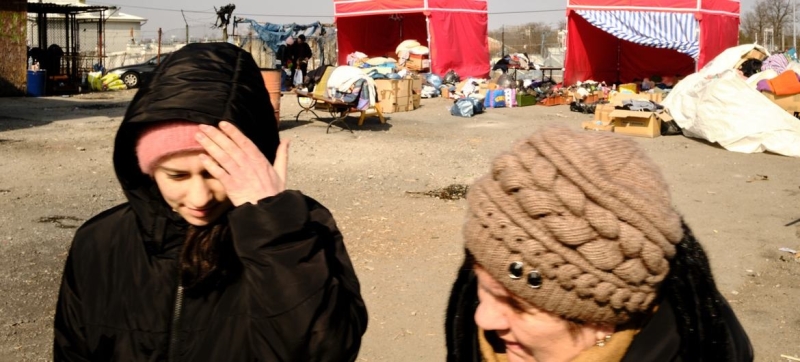
Ukrainian women walk in front of tents set up in Medyka, Poland, to assist refugees fleeing conflict.
Four years into Russia’s full-scale invasion, millions in Ukraine are struggling to keep the lights on and heat their homes, with the crisis taking a particularly heavy toll on women, humanitarian officials warned on Friday.
Fresh from a visit to the country, UN Women’s Chief of Humanitarian Action, Sofia Calltorp, told reporters in Geneva about the suffering of families left without heating, electricity and reliable shelter amid brutal winter conditions. Sixty-five per cent of Ukraine’s energy generation capacity has been destroyed by deliberate attacks.
“These energy blackouts are not just technical disruptions,” she said. “They directly undermine women’s safety, protection and economic security.”
Calltorp explained that extended darkness, lack of street lighting and disrupted transport “severely restrict women’s mobility and increase exposure to harassment and accidents.”
Many Ukrainian women work in sectors hardest hit by prolonged power cuts, including education, healthcare, social services and retail, and are now losing their jobs, the UN Women official added.
No electricity, no school, no salary
“In Kyiv, in a heated tent set up to support citizens, I met Irina,” she said. “She told me: ‘No electricity means no school for my children and no electricity means no job for me. It means no salary.’”
UN Women reported that 2025 was the deadliest year of the conflict for women so far. Since 24 February 2022, more than 5,000 women and girls have been confirmed killed and 14,000 injured, with the real toll likely far higher.
Despite the hardships, Ukraine’s women are “carrying the country forward,” and women-led organisations remain central to the humanitarian response, Calltorp said. They provide vital protection, psychosocial support, emergency aid and livelihood assistance to hundreds of thousands of people but now face serious threats due to funding cuts.
One in three women-led organisations warned they may not survive beyond six months, according to a recent survey on reductions in foreign assistance.
“Due to funding cuts in 2025 and 2026, these organisations are projected to lose at least $53.9 million by the end of the year,” said UN Women’s representative in Ukraine, Sabine Freizer Gunes. “If this continues, an estimated 63,000 women in 2026 will lose access to essential services,” including support for survivors of conflict-related sexual violence.
“There will be more women in need of psychosocial and legal support, less political participation, fewer economic opportunities and slower economic growth,” she said. “Weakening women’s organisations at this moment risks undermining Ukraine’s entire humanitarian and recovery system.”
Vulnerable groups hit hardest
Addressing the broader humanitarian impact of the energy crisis, Jaime Wah, Deputy Head of Delegation for the International Federation of Red Cross and Red Crescent Societies in Ukraine, said power outages disproportionately affect the most vulnerable.
“For older people, persons with disabilities and those with chronic illnesses, this is life-threatening,” she said.
Speaking from Kyiv, Wah noted that while cold homes increase illness, the psychological toll of outages is “equally serious.”
“Prolonged darkness, isolation and constant uncertainty are exhausting communities,” she said. “Many people have experienced traumatic events, yet access to specialised mental health and psychosocial support remains limited.”
The war’s devastating impact on healthcare has been compounded by widespread attacks on medical facilities, according to the World Health Organization.
Over the past four years, the agency has verified more than 2,870 attacks on healthcare facilities, resulting in 233 deaths and 937 injuries among medical staff and patients, said WHO spokesperson Christian Lindmeier.
“Facilities are operating beyond surge capacity, with depleted staff and damaged infrastructure,” he warned.
The number of people living with disabilities has also risen sharply, increasing by nearly 390,000 — more than 10 per cent — since February 2022.
“The figures tell only part of the story,” Lindmeier said. “Behind them lies a much larger crisis — lack of support services, restricted mobility and shortages of essential supplies.”